One gate, and the Door it points to
The Gates of Hell Shall Not Prevail
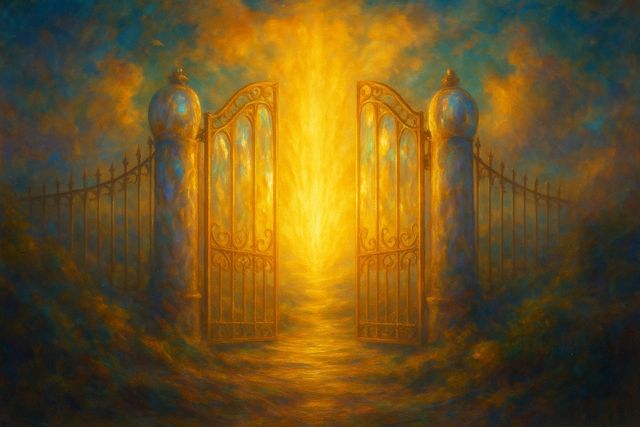
At Caesarea Philippi, in the shadow of a rock face riddled with pagan shrines, the Lord asks His disciples who they say He is. Peter answers that He is the Christ, the Son of the living God, and the Lord replies with a promise that has rung through every century since. Upon this rock, He says in Matthew 16:18, He will build His church, and the gates of hell shall not prevail against it. It is a saying of extraordinary confidence, spoken in a place surrounded by the monuments of other gods. This page dwells on that promise and its striking image. Gates do not attack, they defend. When the Lord says the gates of hell will not prevail, He pictures not a fragile church cowering behind walls but a church on the march, and the gates of death and darkness unable to hold their ground against it. It is a word for the frightened and the weary, a promise that the story does not end in the grave.
“And I say also unto thee, That thou art Peter, and upon this rock I will build my church; and the gates of hell shall not prevail against it.”Matthew 16:18
The gate in Scripture
The confession comes at a turning point in Matthew's Gospel. The Lord has withdrawn with His disciples to the region of Caesarea Philippi, far to the north, and there He presses the great question. First He asks who the crowds say He is, and the answers vary, John the Baptist, Elijah, one of the prophets. Then He asks the disciples directly, and in Matthew 16:16 Peter answers with the confession that He is the Christ, the Son of the living God. This confession is the hinge on which the passage turns. The Lord's response in Matthew 16:17 declares Peter blessed, for flesh and blood did not reveal this to him but the Father in heaven. Then comes the promise of Matthew 16:18, with its play on Peter's name, the rock, and the building of the church upon that rock. Christians have long debated whether the rock is Peter himself, his confession, or the Christ whom he confessed, and the emphases differ across traditions. What none dispute is that the church is built by Christ, that it is His church, and that its foundation is bound up with the truth Peter just spoke. The image of gates repays attention. In the ancient world the gate of a city was the seat of its power, where elders sat in judgment, where councils met, where the strength of a place was concentrated. To speak of the gates of a city was to speak of its might and its rule. So the gates of hell, or of Hades, the realm of the dead, are the concentrated power of death and darkness. The Lord promises that this power will not prevail against His church. The verse that follows, Matthew 16:19, gives to the church the keys of the kingdom, an image of authority to open and to shut. Keys and gates belong together. The picture is of a church entrusted with the keys of heaven's kingdom, advancing against the gates of death's kingdom, and those gates giving way. The saying, spoken among the shrines of dead gods, announces that the living God is building something the grave cannot stop.
What it comes to mean
The most important thing to see is that gates are defensive, not offensive. A gate does not go out to attack, it stands to keep something in or out. When the Lord says the gates of hell will not prevail, He is not picturing His church as a besieged fortress barely holding on against the assaults of darkness. He is picturing the church on the offensive and the gates of death unable to withstand the assault. The church is the one advancing, and hell's strongholds are the ones that cannot hold. This reframes how we read the promise. Many read it as reassurance that the church will survive the attacks of evil, and it is that, but it is more. It is a declaration that death itself, the last and strongest gate, will not keep its prisoners. The gates of Hades held every human being who had ever died, and the Lord announces that these gates will not prevail. His resurrection would soon prove it, when He rose and, as the New Testament later says, holds the keys of death and of Hades. Honesty requires us to admit how unlikely this promise looked and often still looks. The church has been persecuted, scattered, corrupted from within, and pronounced dead more times than can be counted. Empires have set themselves against it. Its own failures have wounded it more deeply than its enemies. And yet it endures, not because of the strength of its members but because of the faithfulness of its Lord. The promise is not that the church will always look strong, but that the gates of death will not finally prevail against what Christ is building. We should be careful, too, not to turn this promise into triumphalism, as though it licensed the church to seek worldly power or to trample its neighbors. The victory the Lord describes is His, won by a cross and an empty tomb, not by conquest or coercion. A church that reaches for the sword to prove the promise has forgotten what kind of King made it. The gates of hell fall not before our might but before the crucified and risen Christ, and the church prevails only insofar as it belongs to Him.
How it points to Christ, the Door
The promise stands or falls on who Jesus is, and that is exactly what the passage establishes first. Before the Lord speaks of building His church, Peter confesses Him as the Christ, the Son of the living God. The church is not built on human resolve or clever strategy, it is built on the reality of who Christ is. Everything in the promise flows from His identity as the Son of the living God, the one over whom death has no claim. It is Christ who makes the gates of hell fail, and He does it not from a distance but by entering death Himself. He went through the very gate He promised would not prevail, laid down His life, and on the third day rose, breaking the hold of the grave from the inside. The reason the gates cannot hold His church is that they could not hold Him. His resurrection is the proof and the ground of the whole promise, the firstfruits of all who belong to Him. So when the church faces the gate of death, whether in the loss of those we love or in the shadow of our own mortality, it does not face it alone or unarmed. It faces it behind the One who has already walked through and come out the other side, holding the keys. The promise of Matthew 16:18 is finally a promise about Him, that the living God has built His people on the Son whom death could not keep, and that where He has gone, His church will follow.
Questions people ask
Does this verse mean the church will always be powerful in the world?
No. The victory the Lord describes is His, won by a cross and an empty tomb, not by worldly power or conquest. The church has often been small, persecuted, and wounded even by its own failures. The promise is not that it will look strong, but that the gates of death will not finally prevail against what Christ is building.
Why are the gates of hell an image of defense rather than attack?
In the ancient world a city's gate was the seat of its power, and gates stand to defend, not to march out. Picturing the gates of hell as unable to prevail casts the church as advancing and death's strongholds as unable to hold. The last gate, death, could not even hold Christ, who rose holding its keys.
