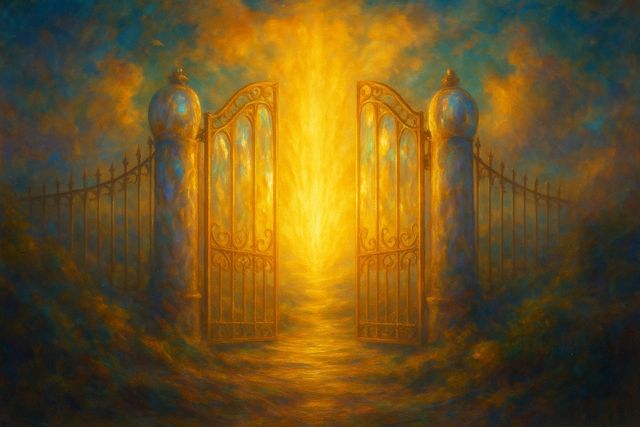
One gate, and the Door it points to
The Gates That Are Never Shut
In the world John knew, a city shut its gates at nightfall. When the sun went down, the bars came across, the watch took their posts, and the walls became what they were built to be, a defense against whatever the dark might bring. To say a city never closed its gates was to say something almost unimaginable: that it feared nothing, that no enemy and no night could ever reach it. Revelation 21:25 says exactly that of the new Jerusalem. Its gates are never shut, because there is no night there. This is where the cluster of gates and doors comes to rest. We began with a door held open at Philadelphia, rose through a door opened in heaven, and stood before gates of costly pearl. Now we learn that those gates never close. The whole movement of the theme has been toward openness, and here it reaches its end: a welcome without end, a home without a curfew, a city so secure that the very idea of shutting the door has become meaningless. This page dwells on that endless open gate.
“And the gates of it shall not be shut at all by day: for there shall be no night there.”Revelation 21:25
The gate in Scripture
The verse sits within the closing description of the new Jerusalem in Revelation 21. John has been shown the city coming down from God, measured and jeweled, with its twelve pearl gates and twelve foundations. He has been told there is no temple in it, for God and the Lamb are its temple, and no sun or moon, for the glory of God is its light and the Lamb its lamp. It is into this flood of uncreated light that the statement about the gates falls. The nations walk by the city's light, and the kings of the earth bring their glory into it. Then Revelation 21:25 states that the gates will never be shut by day, and adds the reason: there will be no night there. The two clauses depend on each other. In the old world gates closed because night came and with it danger; in the city there is no night, so there is no closing. The removal of night is not only the removal of darkness but the removal of every threat that darkness stood for. The gates stay open because there is nothing left to guard against. The following verse continues that the glory and honor of the nations will be brought into the city, echoing the promise of Isaiah 60, where the gates of restored Zion stay open continually so that the wealth of the nations may come in. John is drawing on a prophetic tradition of open gates and gathered peoples, and gathering it to its climax. Yet he does not lose honesty about holiness: he immediately adds that nothing unclean, and no one who practices falsehood, will enter, but only those written in the Lamb's book of life. The open gates are not the erasure of the difference between light and its opposite; they are the triumph of the light. The vision moves on into chapter 22, to the river of the water of life flowing from the throne of God and of the Lamb, and the tree of life on either side, its leaves for the healing of the nations. John adds that there will be no more curse, that God's servants will see His face and bear His name on their foreheads, and that they will reign forever in the unbroken day. The endlessly open gates and the river and the tree belong to one picture: a restored creation, an undone Eden, a place where God dwells with His people and the curse is gone. The gates that never shut are the sign hung over all of it, a permanent announcement that the danger is finished and the welcome is forever.
What it comes to mean
An open gate can mean two opposite things. In a vulnerable city it means recklessness, an invitation to ruin. In an invincible city it means confidence so complete that defense has become unnecessary. The new Jerusalem's gates are open in the second sense. Their perpetual openness is not the lowering of standards but the abolition of threat. There is no night, no enemy, no death, no mourning; and so there is nothing to bar the door against. Security and welcome, which are usually in tension, have become the same thing. The safest city ever imagined is also the most open. This matters because we so often assume that safety requires exclusion, that to be protected we must be closed. The city undoes that assumption at the deepest level. It is not made safe by shutting people out but by the presence of God and the Lamb, whose glory is its light and whose finished work has ended every peril. When the source of safety is God Himself rather than a wall and a bar, the gates can stand open forever without any loss of security. The vision is a picture of what perfect love and perfect safety look like when they are finally the same. Honesty requires holding two things together, and the text does. The gates never shut, and yet nothing unclean enters. This is not a contradiction. The openness is real and the invitation is universal in scope, addressed to all nations, but the city is a place where light has fully won, and what belongs to the night simply has no place left in a world without night. The book will end, in Revelation 22:17, with the widest possible invitation, the Spirit and the bride saying come, and whoever is thirsty invited to take the water of life freely. The open gate and the free invitation are the same gesture. The line the text draws is not to keep the willing out but to describe a city where evil has ceased to exist. Set against the whole cluster, the never shut gates gather up every earlier door. The door no one could shut at Philadelphia is here made permanent and citywide. The door opened in heaven has become a home whose entrances never close. The costly pearl gates are revealed to be not only precious but perpetually open. Every anxious question about whether we will be shut out is answered by a city whose defining feature is that it cannot be closed. The welcome that Christ began by opening a door He completes by building a city that has forgotten how to lock one.
How it points to Christ, the Door
The gates never shut because the Lamb is the city's lamp and there is no night where He is. Everything in the vision that removes the reason for closing gates traces back to Him. He has conquered death, which is why there is no more dying; He has borne judgment, which is why there is no more fear; He is the light, which is why there is no more night. The perpetual openness of the gates is not an abstract security policy but the direct effect of who Christ is and what He has done. He said as much in His earthly ministry. In John 10:9 He named Himself the door through which the sheep go in and out and find pasture, a door of safety and freedom at once. He promised in John 14 to go and prepare a place and to come again and receive His own, so that where He is they would be also. The city with open gates is that prepared place, and the gates stay open because the One who is the door has flung Himself wide and will never again be shut, having died once and now alive forevermore. So the last word of this cluster of doors is a word of rest. The seeker who has spent a life measuring closed doors is shown a city whose gates cannot close, entered through a Lamb who cannot be barred, lit by a glory that ends the night. The invitation stands open at the end of the book precisely because the gates stand open at the center of the city. Come, the Spirit and the bride say, and the gates that never shut are the visible shape of that come, held wide by the pierced and risen hands of Christ, the door who became a whole city of open doors.
Questions people ask
How can the gates never shut if nothing unclean enters the city?
The two are not in conflict. The gates stay open because there is no night and no threat left to guard against, not because standards are lowered. In a city where light has fully won, what belongs to the night has no place to enter. The openness is real and the invitation universal in scope; the city is simply where evil has ceased to exist.
Why does the passage stress that there is no night there?
In the ancient world gates closed at nightfall against the dangers darkness brought. By removing night, the vision removes the very reason gates ever closed. No night means no enemy, no death, no threat, so the gates can stand open forever. The Lamb is the city's lamp, and His finished work is why the darkness, and the closing, are gone.
