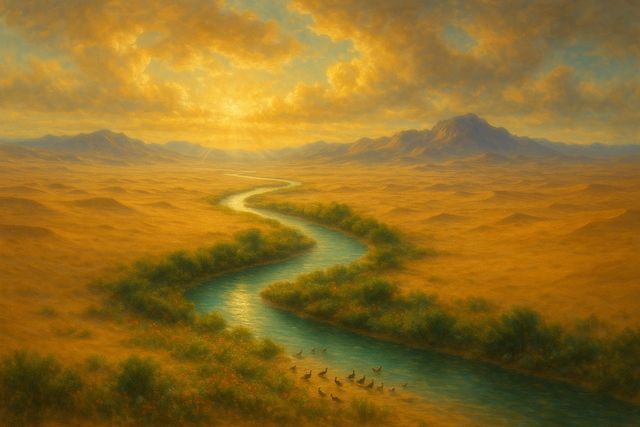
A well in the story of God
The Broken Cisterns
Picture the dry season in ancient Judah, when the summer sun cracks the ground and every household lives by the water it has managed to store. A cistern was a person's insurance against drought, a pit hewn into limestone and sealed with plaster to catch the winter rains. But limestone cracks, and plaster fails, and a farmer might climb down at last into his cistern only to find the floor dry and the walls stained where the water had quietly seeped away. Into that ordinary heartbreak the prophet Jeremiah steps with a word from God, and it lands as grief rather than mere accusation. The tragedy he names is not only that the people are thirsty, but that they walked away from a spring that never runs dry to dig holes that could never hold a thing.
“For my people have committed two evils; they have forsaken me the fountain of living waters, and hewed them out cisterns, broken cisterns, that can hold no water.”Jeremiah 2:13
“O LORD, the hope of Israel, all that forsake thee shall be ashamed, and they that depart from me shall be written in the earth, because they have forsaken the LORD, the fountain of living waters.”Jeremiah 17:13
The well, in its place
A cistern is not a well and not a spring. A well reaches down to water that gathers on its own beneath the earth, and a spring gives water that rises fresh from the ground. A cistern only keeps what rain has already given, and it keeps it only if the rock does not betray it. In Jeremiah's world these plastered pits dotted every hillside and courtyard, dug by hand and prized as security. The prophet chooses this image deliberately. Over against the fountain of living waters he sets the broken cistern, a thing built by human effort, dependent on borrowed supply, and finally unable to hold even that. The picture is exact and unsparing, a monument to labor spent on what cannot last.
What happened here
In Jeremiah's opening chapters God lays out a two-fold charge, and it is the second half that carries the sting. His people had committed one evil, then another. First they forsook Him, the fountain of living waters, the source that gives freely and never fails. Then they set to work, hewing out cisterns for themselves, broken ones that hold no water. Later in the book Jeremiah returns to the same fountain, warning that those who turn from the LORD will be written in the dust because they abandoned the source of living water. There is no drama of judgment here, only the quiet exposure of a bad exchange. The people traded a living spring for the exhausting, futile labor of storing what they could not keep.
How it points to Christ, the living water
Every substitute for God is a broken cistern. We dig them still, out of comfort and status, out of approval and appetite, out of the endless small securities we build against fear. They hold for a season and then the water is gone, and we are left standing in a dry pit we made with our own hands. Jesus comes as the fountain Jeremiah's people forsook, the living water that does not depend on our rain or our patching. To a woman at a well He offered a spring that would rise within her forever, and on a feast day He cried out that anyone who thirsts should come to Him and drink. He does not ask us to store Him up. He asks us to come and keep coming, and He never runs dry.
Questions people ask
What is the difference between a cistern and a well in the Bible?
A cistern was a pit cut into rock and sealed to catch and store rainwater, while a well or spring gave access to naturally occurring water underground. Jeremiah's point turns on this contrast. A cistern only keeps borrowed water and can crack and lose it, whereas the fountain of living waters, God Himself, supplies freely and never fails.
Is Jeremiah speaking of literal water or something spiritual?
He uses a literal, familiar image to name a spiritual reality. Cisterns and springs were everyday concerns in a dry land, so the picture landed instantly. The forsaking he grieves is real, though. His people had turned from God to idols and false securities, trading the living source for substitutes that could not satisfy or last.
