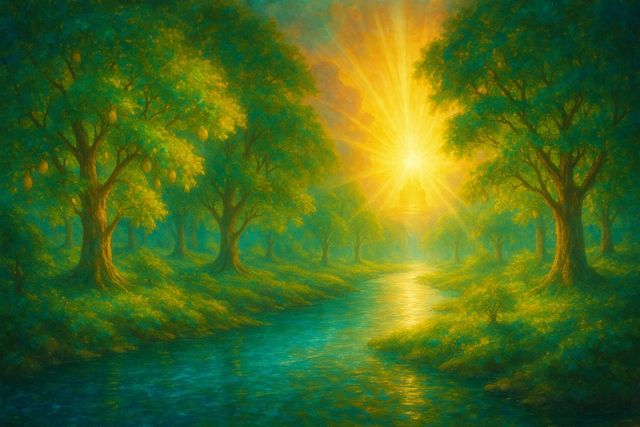
A well in the story of God
Jacob and Rachel at the Well
Jacob comes to the land of the east a hunted man, alone, with his brother's fury behind him and a stone for a pillow still fresh in memory. He has walked far from Beersheba into the fields of Haran, carrying little but a birthright he gained by deceit and a promise he heard at Bethel. Then he sees a well in the open country, three flocks lying beside it, and a great stone laid over its mouth. Shepherds wait there in the sun, unwilling or unable to move the heavy stone alone. It is a scene of thirst and delay, of animals gathered and water sealed away. Into this pause walks a stranger far from home, tired and heartsore, about to discover that the God of Bethel has gone before him even to a field well in a country he has never seen.
“And it came to pass, when Jacob saw Rachel the daughter of Laban his mother’s brother, and the sheep of Laban his mother’s brother, that Jacob went near, and rolled the stone from the well’s mouth, and watered the flock of Laban his mother’s brother.”Genesis 29:10
“And Jacob kissed Rachel, and lifted up his voice, and wept.”Genesis 29:11
The well, in its place
This field well lies near Haran, watering the flocks of the region, and its mouth is closed by a stone so large it usually took several shepherds to roll it aside. The custom, the text explains, was to wait until all the flocks were gathered, then move the stone together and water the sheep, then replace it. This shared labor and shared restraint protected a precious resource in a dry land, keeping the water safe from waste and from any single herdsman's advantage. The well sits in open pasture, a fixed point around which the shepherding life of Haran turned. It is also the family well of Laban's household, the very kin Jacob has traveled to find, so the ground itself is drawing the wanderer toward the place God intends.
What happened here
Jacob asks the shepherds where they are from and learns they know Laban, his mother's brother, and that Laban's daughter Rachel is coming even now with the sheep. When Rachel arrives, something rises in the weary traveler. Alone he rolls away the great stone that normally waited for many hands, and waters his uncle's flock. Then he kisses Rachel, lifts up his voice, and weeps, overcome that his long, fearful journey has ended among his own people. Strength and tears meet in one moment. The exile who fled with nothing finds, at a well in a foreign field, the first sign that he is not forsaken, that the God who promised at Bethel has led him precisely to his mother's kindred and to the woman he will love.
How it points to Christ, the living water
Jacob's tears at the well are the tears of a man who thought himself alone and finds he is met. He moves the immovable stone, and love gives him strength beyond the ordinary. The Gospels take up both images and lift them higher. At the tomb another great stone was rolled away, not by a weary traveler but by the power of God, and the exile of death was ended for all who trust the risen Son. Jacob wept for joy at the reach of God's faithfulness; we weep more deeply at a faithfulness that pursued us to the grave and beyond. Christ is the Shepherd who comes to the well, moves the stone no one else could move, and gathers His scattered flock to living water. Every wanderer's homecoming in Scripture points to the homecoming He secured.
Questions people ask
How could Jacob move a stone that usually took several men?
The text presents it as a striking moment without explaining the mechanics. Some read genuine strength stirred by emotion at seeing Rachel; others note the narrative simply highlights the significance of the meeting. Scripture does not claim a miracle here, so honesty leaves it as a vivid, underexplained detail that underscores how much this homecoming meant to a lonely exile.
Where was this well near Haran?
Haran lay in upper Mesopotamia, in the region of Paddan Aram, and the well is described as a field well serving local flocks. The Bible does not give a precise, identifiable location, and no specific site is confirmed. What matters in the account is that God led Jacob directly to his mother's kindred, not the pinpointing of the well on a map.
