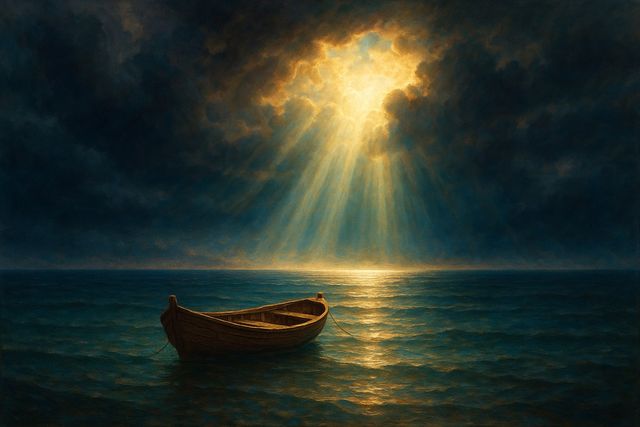
One storm, and the Lord who stills it
Even the Wind and Sea Obey Him
The storm is over, and the disciples are more afraid than when it raged. That is the strange turn at the close of Mark 4. The wind has dropped, the sea lies flat, and instead of relief the men feel a great and holy dread. They turn to one another with a question the calm has forced out of them: what manner of man is this, that even the wind and the sea obey him. The storm frightened their bodies. The stillness frightened their souls. This page belongs to the Storms of the Bible, because the storm on Galilee is finally not about weather at all. It is about a question. Every real encounter with Christ eventually presses this same question upon us, and the calmed sea presses it hardest. Only God commands the deep. So who is this, sleeping and then speaking in a fishing boat, whom the wind and the sea obey?
“And they feared exceedingly, and said one to another, What manner of man is this, that even the wind and the sea obey him?”Mark 4:41
The storm in Scripture
The verse comes at the end of the account in Mark 4, with a close parallel in Matthew 8 and Luke 8. Mark records that after the great calm the disciples feared exceedingly, using language of profound awe, and that they said to one another the words that give this page its title. It is a question left hanging. Mark does not answer it for us; he lets it stand as the climax of the whole scene, the point toward which the sleeping and the storm and the command have all been moving. The form of their words is important. They do not ask what he did, for they saw that. They ask who he is. The Greek is closer to what sort of person, or of what origin. The wonder is not merely at the power but at the category of being that such power implies. Fishermen know that no human voice moves the wind. Something about the man in the boat now escapes every category they had for him, teacher and prophet and healer included. Moments before, they had been afraid of drowning; now they are afraid of him, and that shift is the true subject of the verse. The phrase even the wind and the sea deserves weight. It reaches for the two most untamable forces the disciples knew, the two that in their world stood for everything beyond human control. To say that both obey him is to say that nothing in the created order is exempt from his command. The verb Mark chooses, that they obey, is the language of a servant heeding a master or a subject a king. Matthew records the men marveling in nearly the same terms; Luke says they were afraid and amazed. Across the accounts the note is consistent: not celebration but awe, the recoil of finite men before something that has broken into their boat from beyond the world they knew. Mark places this scene deliberately. It comes as his Gospel is building its central question of who Jesus is, a question that will run through the whole narrative to the confession at Caesarea Philippi and on to the cross, where a Roman soldier will finally name him rightly. The stilled storm is one of the first great pressings of that question, and it comes not as an argument but as a fear, wrung from the disciples by an act they could not explain and could not forget.
What it comes to mean
What the text states is the disciples' question and their fear. What it draws out, for anyone who reads it with the Old Testament in hand, is the answer they could not yet speak. The Scriptures are emphatic and consistent: the God of Israel is the one who rules the sea. Psalm 89 declares that the LORD rules the raging of the sea and stills its waves. Psalm 107 tells of sailors in a storm who cry to the LORD, and he stills it to a calm. Psalm 65 speaks of God stilling the roaring of the seas. Job confesses that God alone treads upon the waves. The pattern admits no exceptions, and every Israelite raised on the Psalms would have known it in the bone. So the disciples' question is, in a sense, already answered by the whole of their own Scriptures. The one who commands the wind and the sea is doing what only God does. Their awe is the correct response, even though they cannot yet name its object. They are standing on the edge of the deepest confession a human being can make, and they feel the ground of it before they can put words to it. Fear is the honest first step toward worship, and Scripture calls that fear the beginning of wisdom. We should be careful not to flatten this into a mere lesson about trusting God in hard times, true as that lesson is elsewhere. The passage is not primarily about the disciples' anxiety; it is about Jesus' identity. To make it only a comfort for our storms is to answer a smaller question than the one the text is asking. The story is not finally asking whether we feel safe. It is asking who is in the boat, and no amount of reassurance about our circumstances can substitute for facing that. And yet the honest reader must also admit what the disciples did not yet know. They did not have the resurrection; they did not have the full confession of the church; they were feeling their way toward a truth not yet spoken plainly to them. Their question was real, not rhetorical. It is a gift that Mark preserves the question unanswered, because it invites every later reader to face it freshly, to feel the same awe, and to be brought by the calmed sea to the same threshold of faith on which those first men stood, trembling in a suddenly quiet boat.
How it points to Christ, Lord of wind and sea
Mark leaves the question open on the page, but he does not leave his reader in doubt about the answer, and here it must be said plainly: the stilling of the sea is a divine act. The Old Testament reserves command over the deep to God alone, and by placing this scene at the head of his Gospel Mark is showing us who Jesus is. The one whom the wind and the sea obey is the LORD of the Psalms, the Creator before whom chaos has no standing. The disciples' fear is the first tremor of a confession the whole Gospel is driving toward. This is why the question matters more than any single storm. Christianity does not stand or fall on whether God calms our particular troubles; it stands or falls on the identity of Jesus of Nazareth. If the one who slept in the stern is truly the Lord of the sea, then everything changes, for it means the Maker of heaven and earth has entered his own creation and gathered fishermen into a boat. The calmed water is a sign pointing past itself to the person, and the person is God with us. Every reader of the Gospel is eventually brought to the disciples' threshold and must answer their question. The wind and the sea have given their testimony by obeying. The Old Testament has told us who commands them. The resurrection has set its seal on the answer. What remains is for us to move, as the first disciples slowly did, from fear to faith, and to name the one in the boat not merely as a wonder but as our Lord and our God.
Questions people ask
Why does Mark leave the disciples' question unanswered?
He lets it stand as the climax of the scene so that every reader must face it. The awe is meant to be felt, not resolved cheaply. Yet the answer is not hidden: the Old Testament reserves command of the sea to God alone, so Mark is guiding us, through the disciples' fear, toward confessing who Jesus truly is.
What does the Old Testament say about God and the sea?
It is consistent that ruling the sea belongs to God alone. Psalm 89 says the LORD rules the raging of the sea and stills its waves; Psalm 107 tells of him calming a storm for desperate sailors; Psalm 65 speaks of him stilling the roaring seas; Job says God treads upon the waves. Christ doing this is a divine act.
