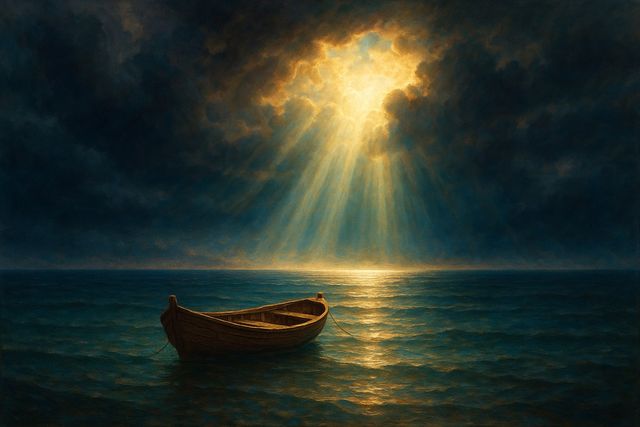
One storm, and the Lord who stills it
The Storm of the Day of the Lord
Scripture does not only speak of the storm as shelter and gentle rain. It also speaks of a storm of another kind, a day it calls the Day of the Lord, and it does not soften the language. The prophet Zephaniah reaches for the darkest weather he knows to describe it: a day of wrath, a day of trouble and distress, a day of clouds and thick darkness. This is the storm as judgment, and it asks to be handled soberly, without relish and without evasion. We will move carefully here. It is possible to speak of judgment in a way that is lurid, that seems almost to enjoy the darkness, and Scripture never does this. It is also possible to empty it of all weight, and Scripture does not do that either. Zephaniah holds a hard truth: that God takes evil seriously enough to answer it, and that the answer is grave. This page tries to hold it as he does, and then to turn toward the Christ who walked into that storm on our behalf.
“That day is a day of wrath, a day of trouble and distress, a day of wasteness and desolation, a day of darkness and gloominess, a day of clouds and thick darkness,”Zephaniah 1:15
The storm in Scripture
Zephaniah prophesied in a time of surface prosperity and deep corruption, and his book opens with sweeping words of judgment. The passage that gives this page its name gathers, in a single breathless run, nearly every word for dread the language has. The great Day of the Lord is near, he says, and hastening quickly. It is a day of wrath, a day of trouble and distress, a day of wasteness and desolation, a day of clouds and thick darkness, a day of the trumpet and alarm against the fortified cities. The piling of phrases is deliberate. Zephaniah does not describe the day with cool precision; he lets the words fall like blows, each one darkening the last. The clouds and thick darkness are the same weather that covered Sinai when God descended, the visible sign that a holiness beyond bearing has drawn near. The trumpet is the war-alarm, the sound that empties a city into panic. This is storm-language pressed into the service of judgment, the sky itself turned into a warning. The prophet is clear about why the day comes. It is aimed at complacency and injustice, at those who have grown thick and settled and say in their hearts that the Lord will do neither good nor ill. Zephaniah's judgment is not random weather; it is the moral answer of a holy God to real and unrepented wrong. He names pride, violence, and the worship of what is not God. The darkness has a cause, and the cause is not on God's side. We should also notice how the storm-language works. Zephaniah does not paint gruesome scenes or dwell on suffering for its own sake; he reaches instead for weather and for sound, clouds and thick darkness and the blast of a trumpet. This is restraint, and it is instructive. The prophet conveys the gravity of the day without ever becoming lurid, letting the darkening sky carry the weight that lurid detail would only cheapen. The darkness is enough. It signals a holiness drawing near that the settled heart has forgotten to reckon with. And yet Zephaniah does not end in darkness, and it would be dishonest to stop where the storm is thickest. The same short book that thunders in its first chapter closes in song. The prophet calls the humble to seek the Lord and be hidden in the day of his anger, and the final chapter breaks into unexpected joy: the Lord in the midst of his people, rejoicing over them, quieting them with his love, singing over them. The book that opens in thick darkness ends with God singing. That arc is part of the message and must not be cut away.
What it comes to mean
We have to begin by taking the darkness seriously, because Scripture does. It is tempting, in a gentle age, to treat judgment as an embarrassment to be explained away. But a God who never answered evil, who met cruelty and injustice with permanent indifference, would not be good; he would be complicit. Zephaniah's storm is, at bottom, the assurance that the world's wrongs are not shrugged at forever. That the day is called a day of wrath is, strangely, bound up with the truth that God cares. At the same time, we must be honest that Christians have long differed on how the final judgment unfolds, on its timing, its scope, and the nature of what lies beyond it. Sincere believers who hold Scripture in high honor have read these things differently for centuries. This page does not pretend to settle those questions, and it is right to name the humility they call for. What Zephaniah gives us is not a map of the end but a moral certainty: that God is holy, that evil will be answered, and that the answer is grave. On the details beyond that, a reverent reader can hold convictions and still hold them with open hands. What Zephaniah will not allow is complacency, and that is the sharpest edge of the passage for us. The people he indicts are not spectacular sinners; they are the settled and the smug, those who assume God is neither watching nor acting. The Day of the Lord is spoken against exactly that assumption. It is a summons to stop living as though our choices carried no weight and our injustices left no mark. Whatever one believes about the last things, the call to sober self-examination stands. And we must let the book end where it ends. Zephaniah does not leave the humble in the storm. He tells them to seek the Lord, to seek righteousness and humility, and it may be they will be hidden in the day of anger. The very language of the shelter passages returns: hidden, covered, kept. And beyond even that shelter, the book closes with God rejoicing over his people with singing. The storm of judgment is real, but for those who take refuge it is not the final word. The final word, Zephaniah insists, is a song.
How it points to Christ, Lord of wind and sea
It is here, at the storm of judgment, that the Gospel speaks most tenderly, because it claims that someone has already stood in the day of wrath for us. When the New Testament describes the death of Jesus, it reaches for Zephaniah's very weather: at midday a darkness fell over the land, thick darkness at the hour of the cross. The Day of the Lord's clouds gathered, and Christ was under them. He entered the storm that judgment is, not as a spectator but as the one it fell upon. This is what keeps the sober truth of judgment from crushing us. The darkness is real, and it is grave, and it is precisely what Christ walked into so that those who take refuge in him might be hidden in the day of anger. Zephaniah told the humble to seek shelter; the Gospel says the shelter has a name and bears the marks of the storm. The one who stilled the sea did not still this tempest but let it break over him. So we turn, finally, not to fear but to the Christ who bore the storm and came out singing on the far side of it. Zephaniah's book ends with God rejoicing over his people, and the Gospel tells us how that joy was purchased. Whatever we cannot yet resolve about the last day, this we can hold: that the God who answers evil has, in Christ, taken the answer upon himself, and that those who run to him are hidden. The right response to the Day of the Lord is not to speculate about the darkness but to step under the one shelter that has already endured it.
Questions people ask
Do all Christians agree on how final judgment works?
No. Sincere believers who honor Scripture have long differed on the timing, scope, and nature of the final judgment. This page does not try to settle those questions. What Zephaniah makes clear is narrower and surer: God is holy, evil will be answered, and the answer is grave.
Isn't a God of wrath incompatible with a God of love?
Zephaniah holds both in one short book, opening in thick darkness and closing with God singing over his people. A God wholly indifferent to cruelty and injustice would not be loving but complicit. The wrath is the measure of how seriously he takes the evil that love refuses to ignore.
