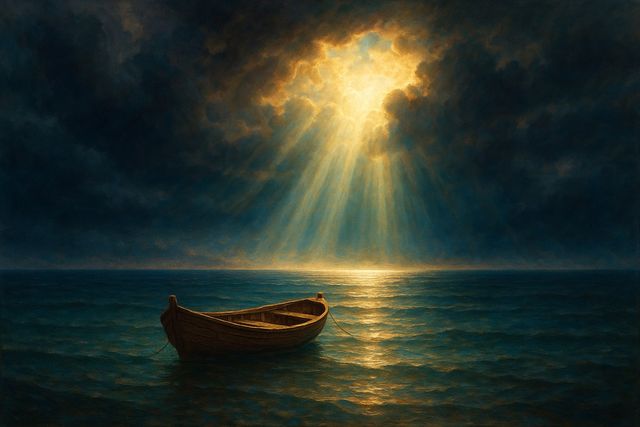
One storm, and the Lord who stills it
Paul's Shipwreck
Not every storm in Scripture ends with a word of command and a great calm. Some run their full course. In Acts 27, Paul is a prisoner being taken to Rome, and the ship carrying him is caught by a wind so violent that Luke names it, Euroclydon, the northeaster. For days there is no sun, no stars, no slackening. Acts 27:20 says that all hope of being saved was at last taken away. That is the honest verdict of experienced sailors, and Luke, who was aboard, does not soften it. And yet not one life is lost. The ship is destroyed and every soul reaches land. This is a different kind of storm story, one where God's purpose does not cancel the wreck but sails straight through it, and where the promise given is presence and preservation, not escape from the sea.
“But not long after there arose against it a tempestuous wind, called Euroclydon.”Acts 27:14
“And when neither sun nor stars in many days appeared, and no small tempest lay on us, all hope that we should be saved was then taken away.”Acts 27:20
The storm in Scripture
The voyage is doomed from a decision Paul warned against. In Acts 27:9 through 27:11 he counsels against sailing on, judging the season dangerous, but the centurion trusts the ship's master and owner instead, and they put out hoping to reach a better harbor for winter. A gentle south wind seems to confirm the choice, as 27:13 notes, and then everything turns. Acts 27:14 records the tempestuous wind called Euroclydon striking down from the land. The ship cannot bear up into it and is driven. The crew undergirds the hull with cables, lowers gear, and begins throwing cargo and then the ship's tackle overboard with their own hands, as 27:18 and 27:19 describe. Day after day the sky is closed. Then comes the terrible summary of 27:20, that neither sun nor stars appeared for many days, no small tempest lay on them, and all hope that they should be saved was taken away. Luke does not rush past the physical ordeal. Acts 27:18 notes that they were exceedingly tossed with the tempest. Long fasting had left the men without appetite or strength, as 27:21 and later 27:33 record, for no one had eaten for many days in the pitch and heave of the hold. They had lightened the ship of everything they could throw over. This is not a brief squall but a two-week siege of wind and darkness that stripped away cargo, gear, food, and finally hope itself. Luke was aboard, writing in the first person plural, and he reports the exhaustion of it with a survivor's plainness. Into that hopelessness Paul stands and speaks. In Acts 27:21 through 27:26 he tells them an angel of the God whose he is and whom he serves stood by him in the night, saying he must be brought before Caesar, and that God has granted him all who sail with him. Not one life will be lost, only the ship. Paul says he believes God, that it will be exactly as he was told, though they must run aground on some island. He even begins with a hard honesty, acknowledging in 27:21 that they should have heeded his earlier counsel not to sail; he does not use the promise to erase the folly that brought them there. The closing act confirms the honesty of the promise. On the fourteenth night, 27:27, the sailors sense land. There is a final crisis when some try to escape in the lifeboat and Paul insists in 27:31 that unless they stay in the ship they cannot be saved. At dawn he urges them all to eat and gives thanks to God before them, as 27:35 records. Then the ship strikes a sandbar and breaks apart under the pounding surf in 27:41. Yet 27:44 ends it: some on planks, some on broken pieces of the ship, they all escaped safe to land.
What it comes to mean
The stated meaning is exact and should not be inflated. God promised, through Paul, that no life would be lost but the ship would be. Acts 27:22 and 27:26 say both halves plainly. The promise was preservation of every person and the certainty of running aground. It was never a promise that the storm would stop or the vessel be spared. Honesty requires us to preach the promise God actually made, not a larger one He did not. This matters because it corrects a common instinct. We tend to assume that if God is with someone, the trouble will be lifted. Acts 27 flatly denies this. The man of God on that ship is the reason all are spared, and still the northeaster blows for two weeks, still the cargo goes overboard, still the ship is torn apart on the rocks. God's favor and a total shipwreck occupy the same voyage without contradiction. What is drawn out from the account, beyond its stated promise, is the manner of God's keeping. He preserves through means, not around them. Paul warns before sailing, insists the sailors stay aboard, and calls everyone to eat and take strength. Divine certainty in 27:24 does not make human wisdom idle; it enlists it. The drawn-out lesson is that trusting God's word and acting prudently are not rivals. The same Paul who says he believes God tells the soldiers that the men in the lifeboat must remain if they are to be saved. There is a further honest note in Paul's own status. He is a prisoner in chains, not a free agent, and the storm falls on a ship he did not choose to board. God's larger purpose, that Paul must testify at Rome, is being accomplished through a chain of events that includes a bad decision, a violent storm, and a wreck. The passage does not present the storm as punishment or as a puzzle to be decoded. It presents it as the rough road on which a sovereign purpose is quietly, certainly moving. It is worth noticing, too, what the promise did to the men who received it. Before Paul's word, the sailors were plotting to abandon ship and the whole company had given up eating. After it, Paul is able to steady them, to keep the crew aboard, and to gather them around a meal in the storm's teeth. The word of God did not calm the sea, but it visibly changed the people on the boat. The certainty God gave through Paul became courage in men who had none, which is its own kind of deliverance, worked in the heart while the wind still howled outside. Luke records the shift plainly: after the meal, 27:36 says, they were all of good cheer.
How it points to Christ, Lord of wind and sea
Paul on the wrecking ship is a servant walking in the pattern of his Lord. The God he serves does not lift him out of the storm; He stands by him in it, in the night, with a word that steadies not only Paul but every soul aboard. That is the same shape as the cross and the empty tomb, where God's purpose was accomplished not by avoiding the worst but by passing through it and bringing life out the far side. The promise Paul carries is Christ's kind of promise. Jesus told His own that in the world they would have tribulation, and in the same breath told them to take heart because He had overcome the world. Acts 27 is that word tested at sea. The tribulation is real and total; the ship is lost. And the deliverance is real and complete; not one is lost. Presence in the storm, not exemption from it, is the gospel's consistent gift, because the Lord who gives it went through the deepest storm Himself. So the shipwreck preaches Christ by refusing to pretend. It will not promise smooth water to make God look good. It promises what God promised: I am with you, and I will bring you through. The ship may break. The purpose will not. And every soul the Lord has granted to His servant reaches the shore.
Questions people ask
Why didn't God stop the storm if Paul was faithful?
Because the promise God gave in Acts 27:22 and 27:24 was preservation of every life and the certainty of running aground, not the calming of the sea. Favor and total shipwreck share the same voyage. Scripture will not let us assume God's presence means trouble is lifted; here it means being brought safely through it.
Does God's certainty make human effort unnecessary?
No. Paul warned before sailing, insisted the crew stay aboard in 27:31, and urged everyone to eat and take strength. Divine certainty in 27:24 enlisted human prudence rather than replacing it. Trusting God's word and acting wisely are not rivals in this account; God preserved all aboard through means, not around them.
