The Great Basilica
The Sacred Art Gallery: seventeen original paintings, each in the spirit of a different Christian tradition
The Sacred Art Gallery is a set of seventeen original paintings that hang in The Living Bread's Great Basilica, each illustrating one Bible passage and painted in the spirit of a different Christian tradition, from the earliest catacomb frescoes of Rome to Ethiopian, Andean, Korean, Georgian and contemporary African painting. They are original images made with an AI image model and chosen by hand, and they copy no older painting.
At a glance
| Paintings | Seventeen, each tied to a Scripture reference |
|---|---|
| Where they hang | Twelve in the niches of the Grand Hall, three in the passage of witnesses and two at the Garden of Gethsemane |
| How they were made | Original images generated for The Living Bread with the gpt-image-2 model on 23 and 24 November 2026 |
| How they were chosen | Every candidate was compared side by side for hands, faces, figure counts, wings, edges and lettering; the other candidate was set aside for each |
| Style | Each is painted in the spirit of a different tradition and copies no older painting |
| Likeness | An artistic interpretation; no authenticated likeness of any person in these pictures survives |
| Image rights | Original works of The Living Bread, not a copy of any artist's painting |
What the gallery is
Churches have always used pictures to carry the Bible to people who needed to see it as well as hear it. The Basilica hangs seventeen paintings for that purpose. Twelve stand in niches along the two long walls of the Grand Hall of Saint Michael, three hang in the passage of witnesses, and two hang at the Garden of Gethsemane. Each illustrates a single passage of Scripture, and the reference is stated beside it.
What marks the gallery is that it does not paint everything in one manner. A single Western style repeated across a whole church makes the Bible look like the property of one civilization, and the Body of Christ is not that. So each of the seventeen is made in the spirit of a different tradition of Christian painting, so that the visitor walks along the wall from Ethiopia to Mexico to Korea and back to Rome.
How the paintings were made, plainly
The paintings are original images made for The Living Bread with an image model, gpt-image-2, on 23 and 24 November 2026. They are not photographs, not scans of older paintings and not the work of a named living artist. Each was generated as a candidate, and the other candidate for each was set aside. The person who built the gallery looked at every pair side by side and checked hands, faces, the number of figures against the Bible passage, wings, the edges of the frame, stray lettering and duplicated figures. The owner reviews all content.
The setting aside is part of the record, and it is printed in each entry below: the candidate that was kept and the reason the other was not. For example the rejected candidate of the Angel Gabriel had wing tips cut by the edges, and the rejected candidate of the Gethsemane prayer showed only two sleeping disciples when the passage has three.
The notice that goes with every picture
The gallery's two notices are fixed and appear wherever the paintings appear. The first is about likeness and the second is about Christ.
An artistic interpretation. No authenticated likeness of any person in these pictures survives.
Christ is shown by the long established conventions of Christian art (a cross in the halo, a calm gaze, an open hand). It claims no likeness.
Twelve paintings in the niches of the Grand Hall
The first twelve hang in the niches of the hall, six on each long wall. They run from angels in the Bible, which suits the hall's theme, to the parables and the sayings of Jesus. Each entry gives what Scripture says, what the painter imagined and the tradition it speaks in.
The Angel Gabriel Brings the Good News
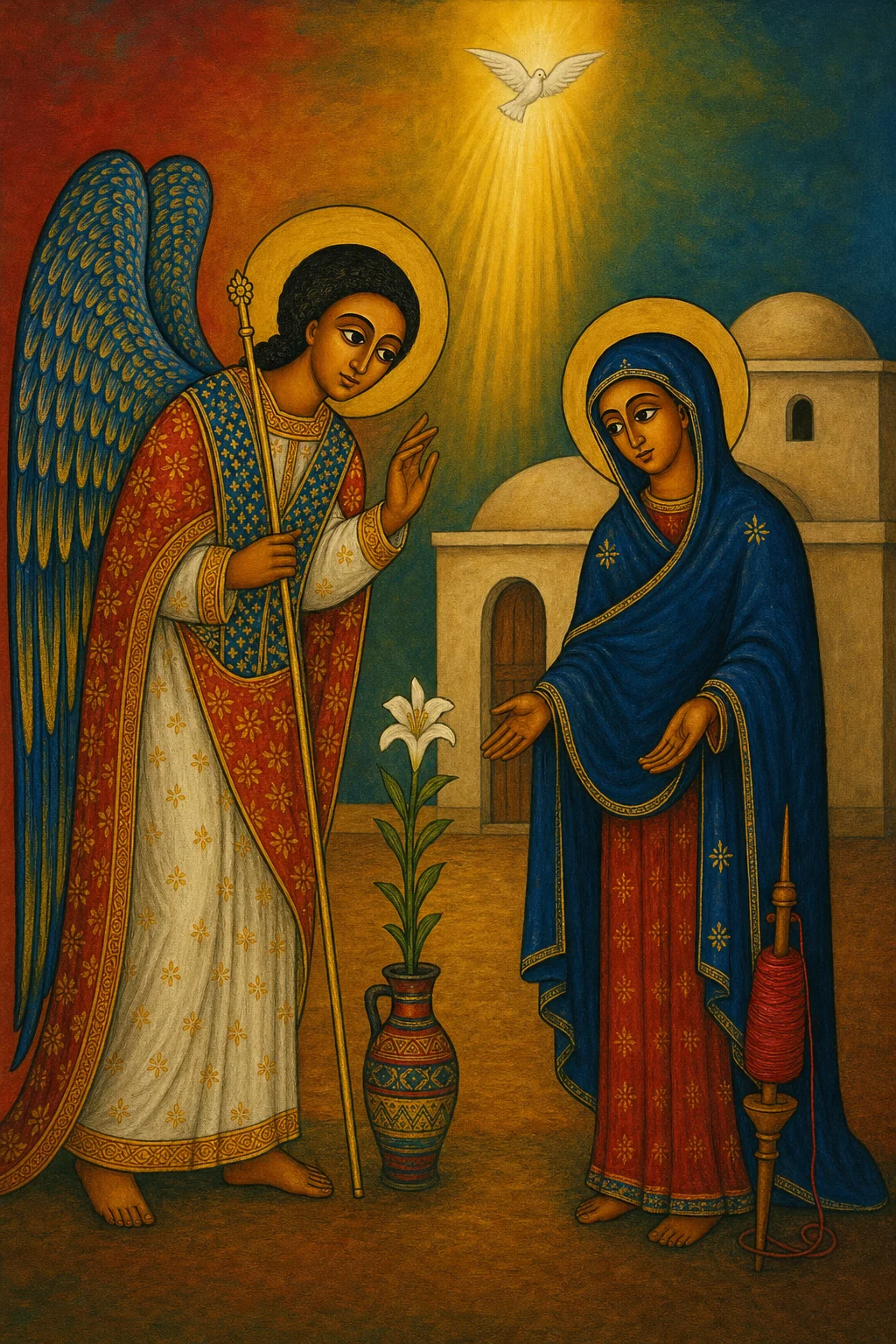
An angel sent from God greets a young woman of Nazareth. Painted in the spirit of the Ethiopian and Coptic Christian tradition, with bold outlines and bright flat colour.
What Scripture says. Luke tells that the angel Gabriel was sent to Nazareth to a young woman named Mary, and that she answered with trust.
What the painter imagined. The wings, the staff, the lily and the dove, the patterned cloth and the plain domed house are the painter's own. Scripture does not describe them.
The tradition it speaks in. The Ethiopian and Coptic churches have painted the Gospel stories for many centuries with strong outlines, large calm eyes and fields of saturated colour. This picture is made in the spirit of that tradition. It is an original work and copies no older painting.
How it was made and chosen. An original image made for The Living Bread with the gpt-image-2 model. It copies no older painting. The builder who chose it wrote: two figures, correct hands, no lettering; wing tip meets the left edge a little. The other candidate, variant 1, was set aside because wing tips cut by the left and top edges; the other candidate is richer.
The Host of Heaven Sings to the Shepherds
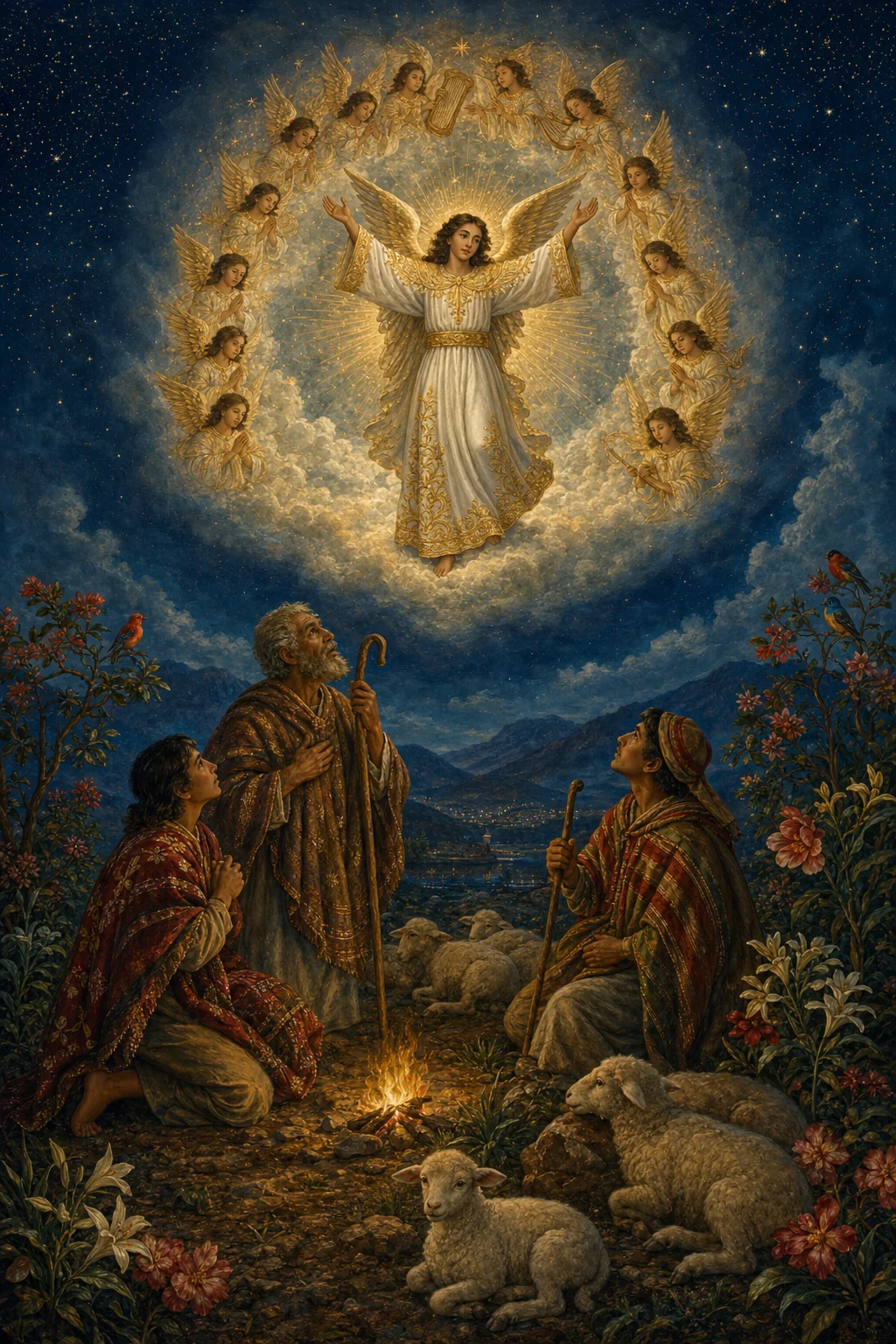
Shepherds keeping watch at night hear the good news first. Painted in the spirit of the devotional painting of the Andes and Mexico, with warm earth colours and gold.
What Scripture says. Luke tells that shepherds in the fields at night were met by an angel and then by a great company of the heavenly host, praising God.
What the painter imagined. The number of the singing angels, the ring of light, the mountains, the flowers and the clothing of the shepherds are the painter's own.
The tradition it speaks in. Painters of the Andes and of Mexico set the Gospel in the land and the cloth around them, with gold patterns and a crowd of flowers and birds. This picture is made in the spirit of that tradition and is an original work.
How it was made and chosen. An original image made for The Living Bread with the gpt-image-2 model. It copies no older painting. The builder who chose it wrote: three shepherds, one great angel in a ring of singing angels. The other candidate, variant 1, was set aside because ring of angels overcrowded and the great angel lost in it.
The Angel at the Empty Tomb
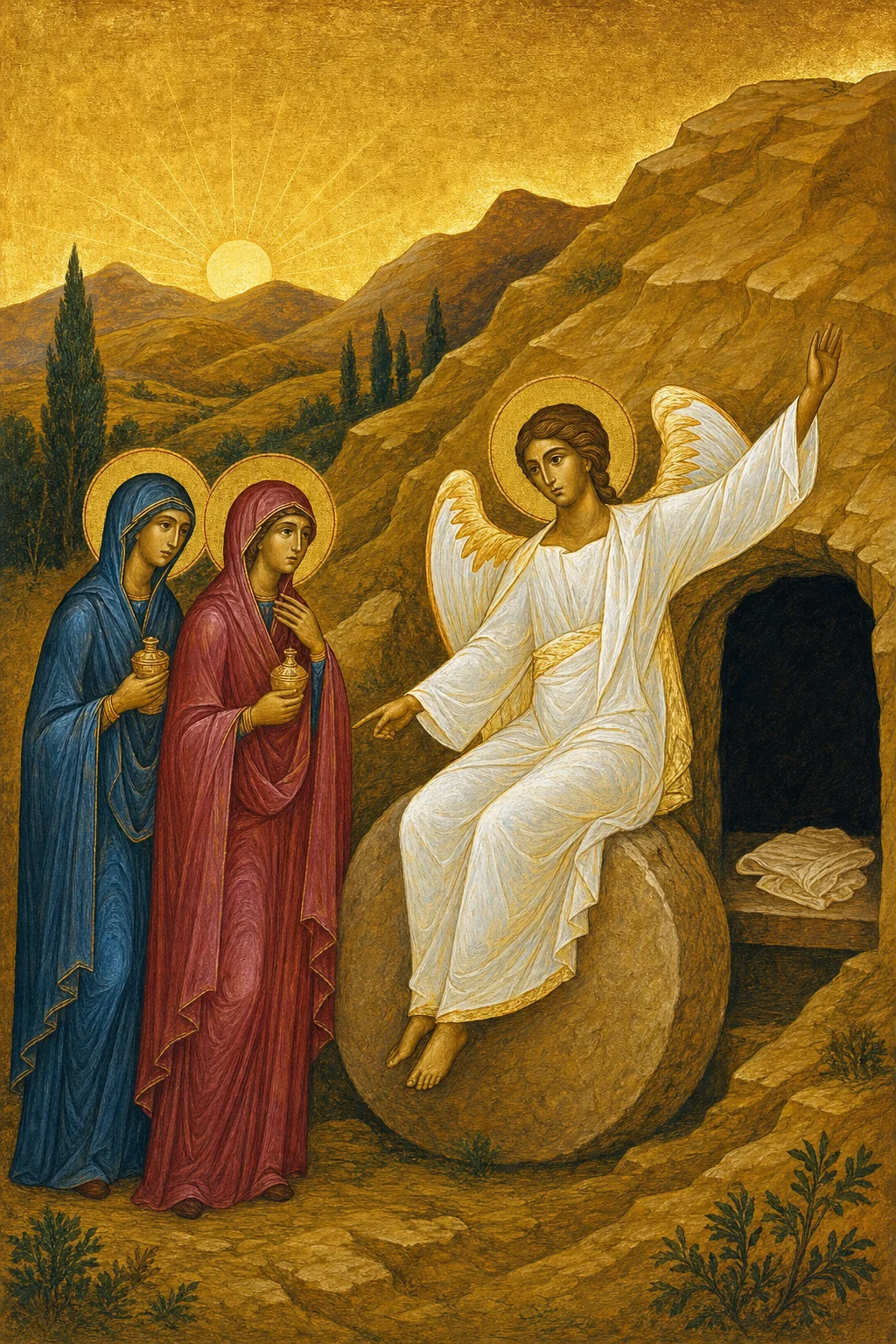
At dawn two women come to a tomb and find the stone rolled away. Painted in the spirit of Russian and Byzantine icons, on a ground of gold.
What Scripture says. Matthew tells that an angel rolled the stone away and sat on it, and told the women that Jesus is not here, because He has risen.
What the painter imagined. The gold sky, the rocky hills, the cypress trees and the colour of the women's cloaks are the painter's own.
The tradition it speaks in. Icon painters in the Byzantine and Russian churches use a gold ground to show that the scene stands in the light of God, and long calm figures to keep the picture quiet. This picture is made in that spirit as an original work.
How it was made and chosen. An original image made for The Living Bread with the gpt-image-2 model. It copies no older painting. The builder who chose it wrote: one angel, two women, whole figures inside the frame. The other candidate, variant 2, was set aside because the angel's hand and the tomb cut at the right edge.
The Seraph Touches the Prophet
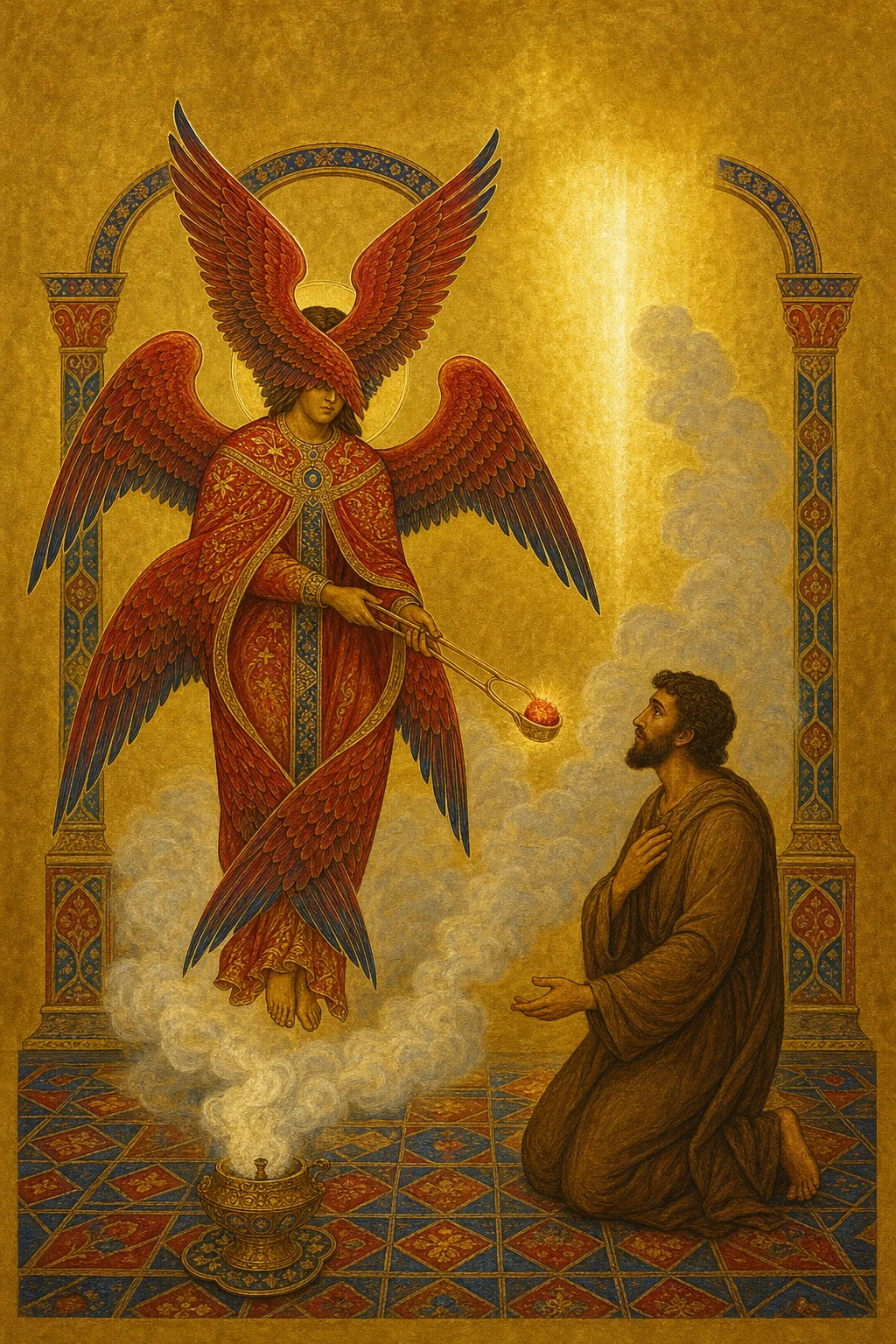
In the temple a seraph with six wings brings a coal from the altar to a prophet who is afraid. Painted in the spirit of Armenian and Syriac illuminated manuscripts.
What Scripture says. Isaiah describes seraphs with six wings who call out to one another, and one who touched his lips with a coal from the altar.
What the painter imagined. The colours of the wings, the patterned floor, the clouds of incense and the pillars are the painter's own. No one is drawn on the throne: the prophet saw the Lord, and this picture shows only a great light.
The tradition it speaks in. Armenian and Syriac scribes painted jewel bright pictures in the margins and pages of their Gospels and prophets, with fine pattern and gold. This picture is made in that spirit as an original work.
How it was made and chosen. An original image made for The Living Bread with the gpt-image-2 model. It copies no older painting. The builder who chose it wrote: one seraph with six wings, one prophet, no figure on a throne. The other candidate, variant 2, was set aside because the seraph's face uncovered and wing tips near the edge; the covered face follows the passage better.
The Angel Frees Peter from Prison
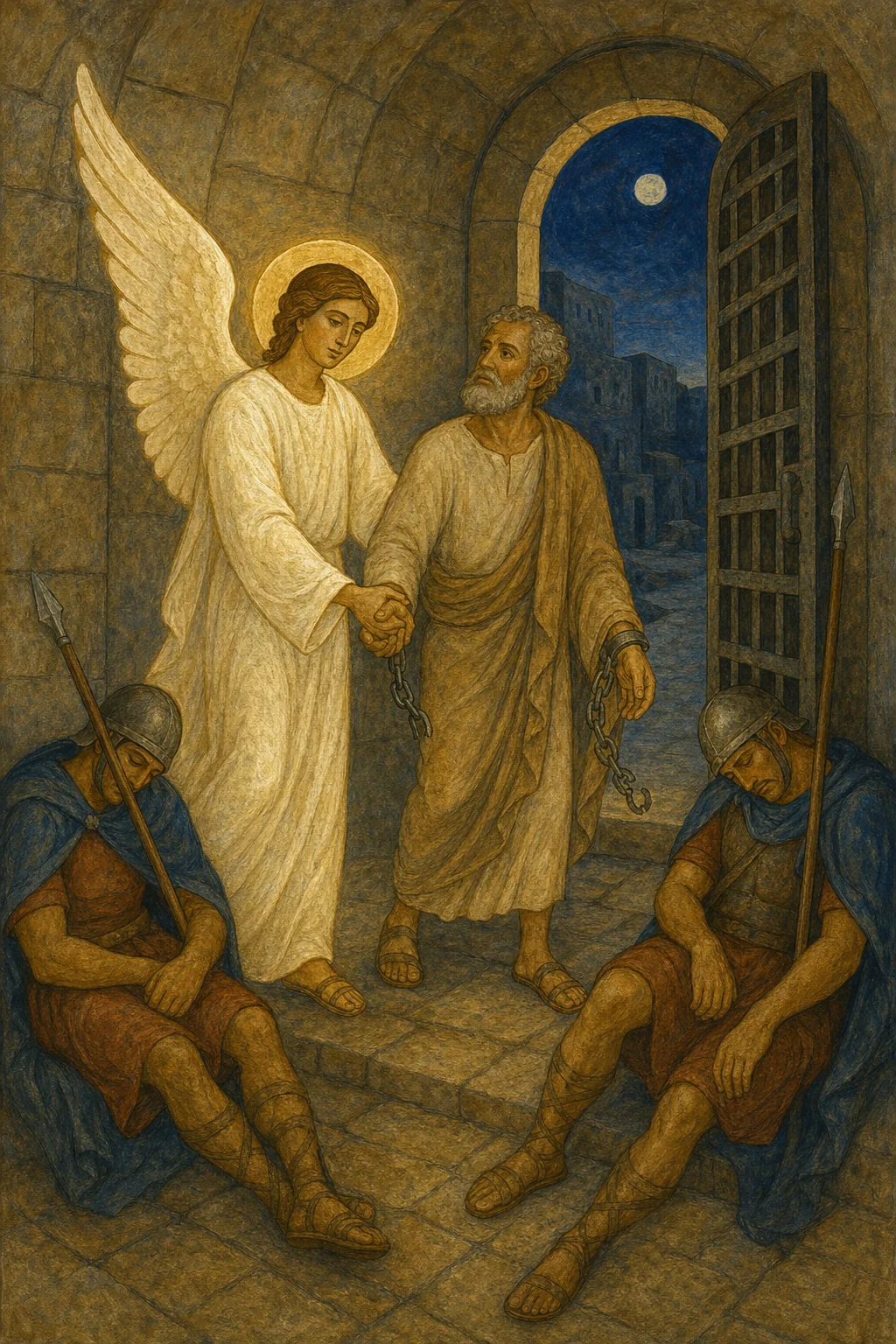
While the church prays, an angel leads an apostle out of prison. Painted in the spirit of the Romanesque church frescoes of Europe.
What Scripture says. Acts tells that Peter was kept in prison and that the church was earnestly praying for him, and that an angel led him out past the guards and through the gate.
What the painter imagined. The shape of the cell, the faces and the clothes of the guards, and the moonlit town are the painter's own.
The tradition it speaks in. Romanesque church painters worked in ochre, terracotta and blue, with strong outlines and plain solid forms that a whole congregation could read from far away. This picture is made in that spirit as an original work.
How it was made and chosen. An original image made for The Living Bread with the gpt-image-2 model. It copies no older painting. The builder who chose it wrote: angel, Peter, two sleeping guards; chains falling. The other candidate, variant 2, was set aside because the angel's wing tip touches the top edge; a guard's foot is cropped.
Angels on the Ladder of Heaven
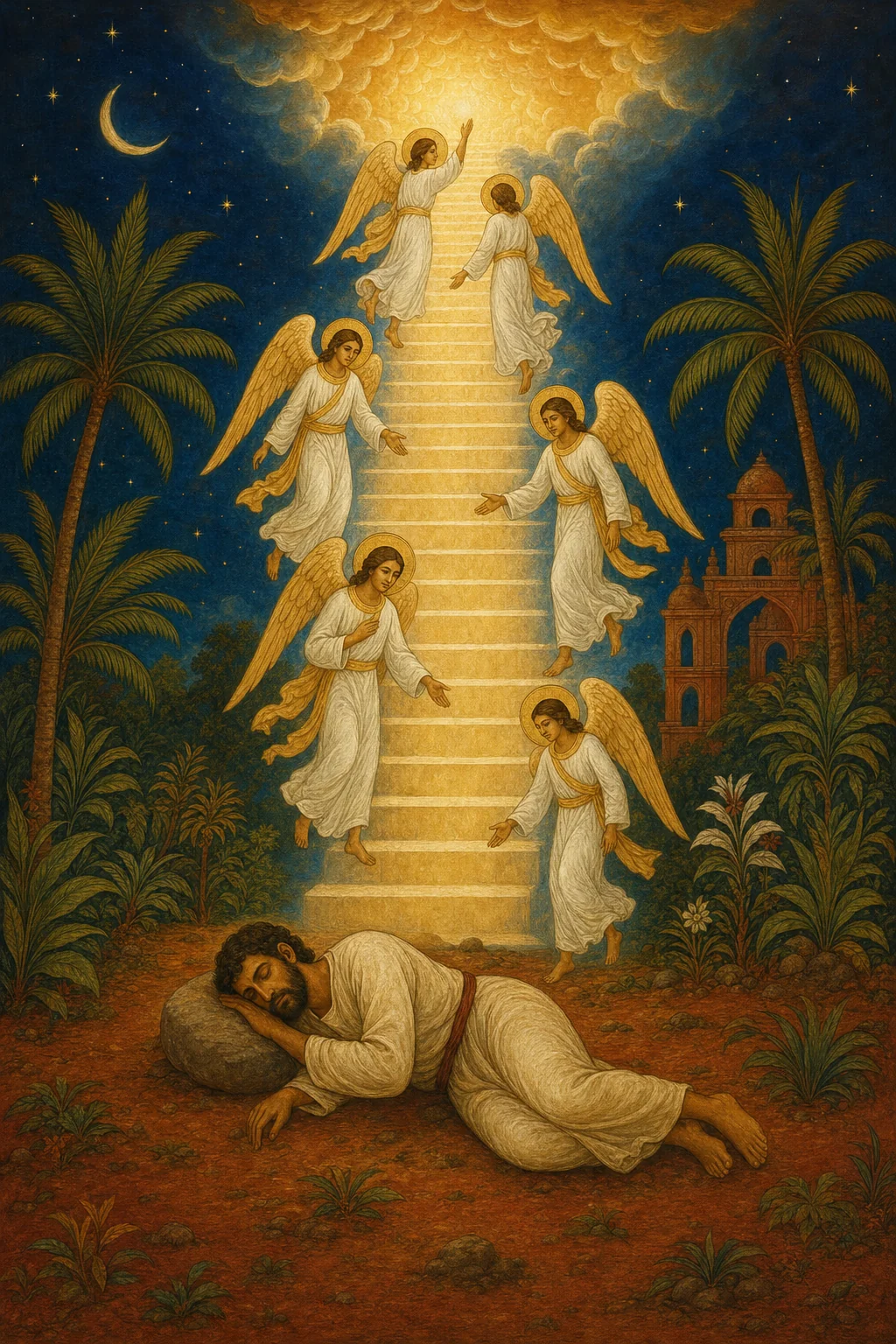
A man alone in the wilderness dreams of heaven opened. Painted in the spirit of the Christian murals of Kerala in South India.
What Scripture says. Genesis tells that Jacob slept with a stone for a pillow and dreamed of a stairway set on the earth with its top reaching to heaven, and angels of God going up and down on it.
What the painter imagined. The palms, the red earth, the number of the angels and the small towers among the trees are the painter's own.
The tradition it speaks in. The churches of Kerala in South India are among the oldest in the world. Their painters use red ochre, deep green and gold, and a rhythmic line. This picture is made in the spirit of that tradition as an original work.
How it was made and chosen. An original image made for The Living Bread with the gpt-image-2 model. It copies no older painting. The builder who chose it wrote: six angels on the stair, a church tower in the trees. The other candidate, variant 2, was set aside because only five angels and a small shrine with an idol like figure, which the Basilica does not hang.
Jesus Calls the Fishermen
By a lake at dawn Jesus calls fishermen to follow Him. Painted in the spirit of Chinese Christian painting, with soft ink wash and gold.
What Scripture says. Matthew tells that Jesus saw two brothers casting a net into the sea and said to them, Follow me, and that they left their nets at once.
What the painter imagined. The mist, the mountains, the boat and the clothing are the painter's own, and the setting borrows the look of Chinese ink painting. Christ is shown by the old conventions of sacred art and no likeness is claimed.
The tradition it speaks in. Christians in China have painted the Gospel in ink and gold for more than a thousand years, with mountains, mist and fine brushwork. This picture is made in that spirit as an original work.
How it was made and chosen. An original image made for The Living Bread with the gpt-image-2 model. It copies no older painting. The builder who chose it wrote: Christ by convention only, three fishermen, a smaller face than the other candidate. The other candidate, variant 2, was set aside because Christ's face larger and closer to a naturalistic portrait than the sacred painting convention.
The Good Samaritan
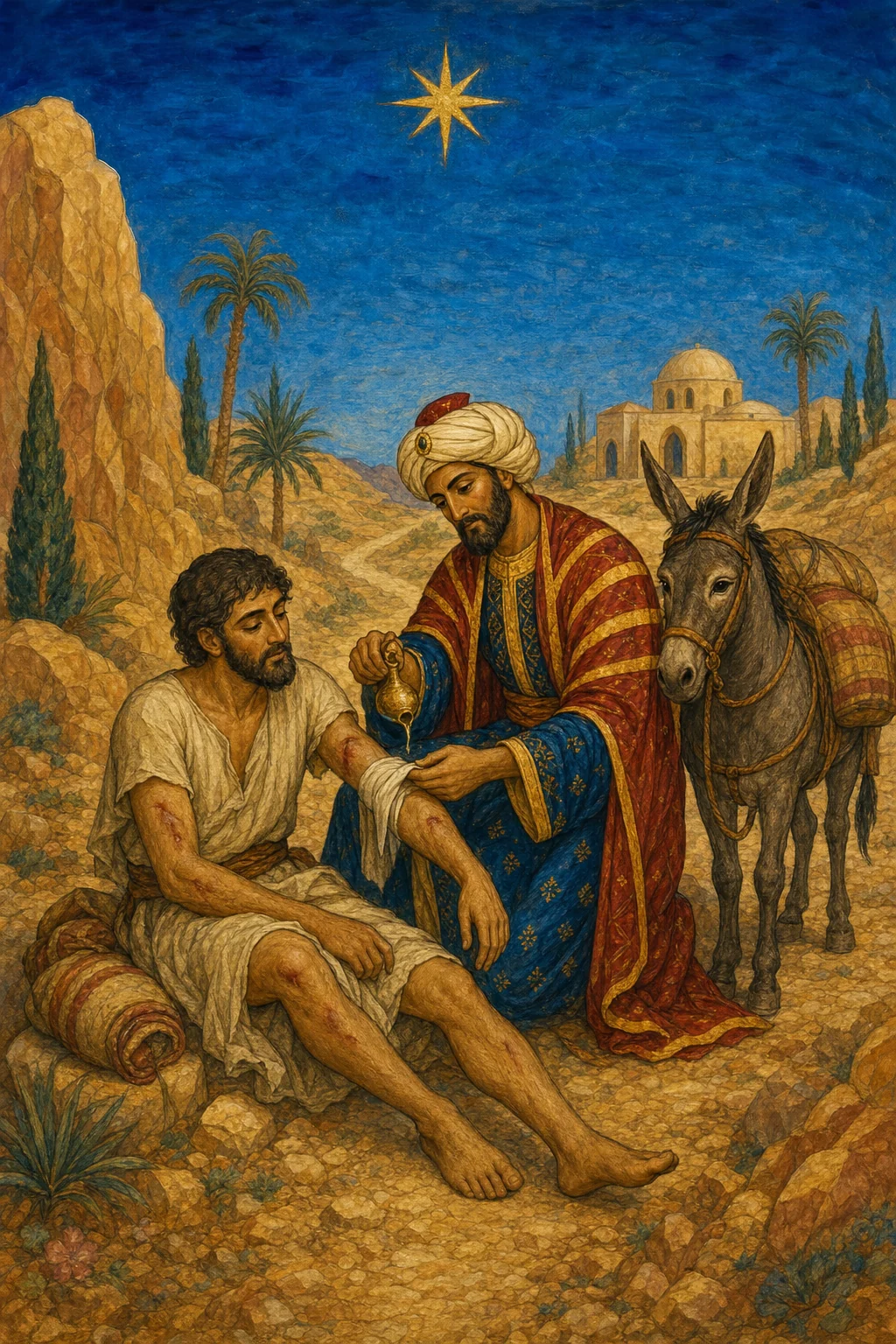
A stranger stops for a wounded man on a desert road. Painted in the spirit of Syriac and Middle Eastern Gospel manuscripts.
What Scripture says. In the story Jesus told, a man was left half dead on the road, and a Samaritan, a stranger, bound his wounds, carried him to an inn and paid for his care.
What the painter imagined. The turban, the rocks, the palm and the inn are the painter's own. Jesus told the story as a parable, so the scene is a picture of the story and not of an event.
The tradition it speaks in. The Christians of Syria and the Middle East illuminated their Gospel books with tall figures, red and gold bands and deep blue skies. This picture is made in that spirit as an original work.
How it was made and chosen. An original image made for The Living Bread with the gpt-image-2 model. It copies no older painting. The builder who chose it wrote: two people and a donkey, hands correct. The other candidate, variant 1, was set aside because the donkey cut at the left edge and the hands of the wounded man crowded.
The Father Welcomes the Returning Son
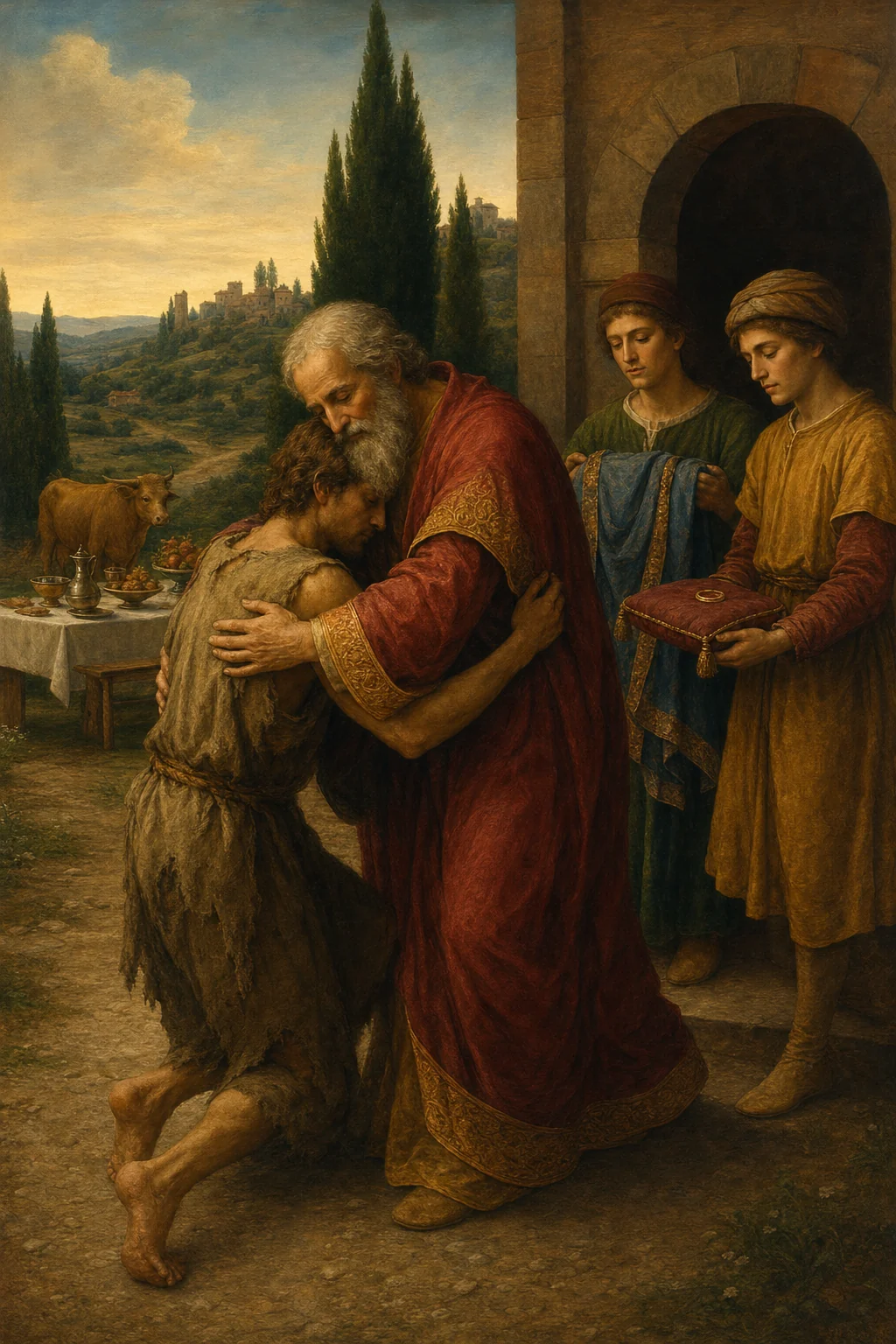
A father runs to meet the son who left. Painted in the spirit of the early Italian Renaissance, with warm glazes and a hill landscape.
What Scripture says. In the story Jesus told, a father saw his son while he was still a long way off, ran to him, embraced him and kissed him, and called for a robe, a ring and a feast.
What the painter imagined. The house, the cypress hills and the faces of the servants are the painter's own. It is a parable, so the picture shows the story and not a recorded event.
The tradition it speaks in. Painters of the early Italian Renaissance worked in glazes of warm colour, with soft light and quiet dignity of cloth and gesture. This picture is made in that spirit as an original work.
How it was made and chosen. An original image made for The Living Bread with the gpt-image-2 model. It copies no older painting. The builder who chose it wrote: four figures, all inside the frame. The other candidate, variant 1, was set aside because a servant cut by the right edge.
The Sower Goes Out to Sow
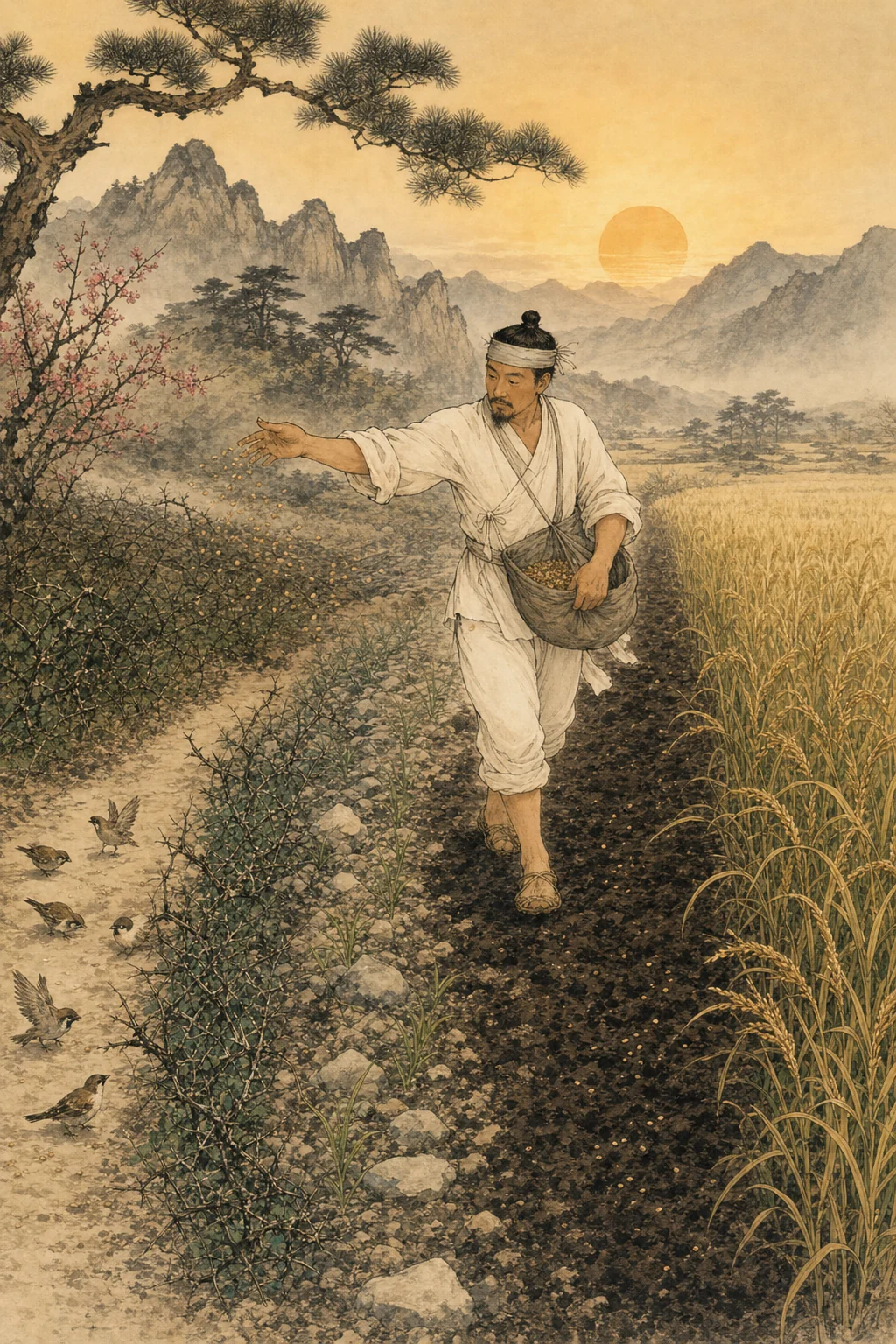
A farmer scatters seed and the ground decides what grows. Painted in the spirit of traditional Korean painting, with ink wash and quiet colour.
What Scripture says. Jesus told of a sower whose seed fell on a path, on rocky ground, among thorns and on good soil, and he explained the story to His disciples.
What the painter imagined. The mountains, the pine, the clothing of the farmer and the bands of different ground are the painter's own. It is a parable, so the picture shows the story and not a recorded event.
The tradition it speaks in. Korean painters have long worked in ink wash and muted colour with fine lines and a sense of open air. Christians in Korea have used that language for the Gospel. This picture is made in that spirit as an original work.
How it was made and chosen. An original image made for The Living Bread with the gpt-image-2 model. It copies no older painting. The builder who chose it wrote: one sower centred, four kinds of ground. The other candidate, variant 1, was set aside because the sower stands at the left edge and the four grounds read less clearly.
The Good Shepherd
Jesus says that He is the good shepherd who knows His sheep. Painted in the spirit of the earliest Christian art, the catacomb frescoes of Rome.
What Scripture says. In John, Jesus says that He is the good shepherd, that the good shepherd lays down his life for the sheep, and that He knows His own.
What the painter imagined. The pasture, the stream, the olive trees and the clothing are the painter's own. Christ is shown by the old conventions of sacred art and no likeness is claimed.
The tradition it speaks in. A shepherd carrying a lamb is one of the oldest pictures in Christian art and is found in the Roman catacombs from the third century. This picture is made in the spirit of those frescoes as an original work.
How it was made and chosen. An original image made for The Living Bread with the gpt-image-2 model. It copies no older painting. The builder who chose it wrote: Christ by convention only, lamb on the shoulders, calm. The other candidate, variant 1, was set aside because the lamb and the halo crowd the top of the picture; the face is smaller but the composition weaker.
The True Vine and the Branches
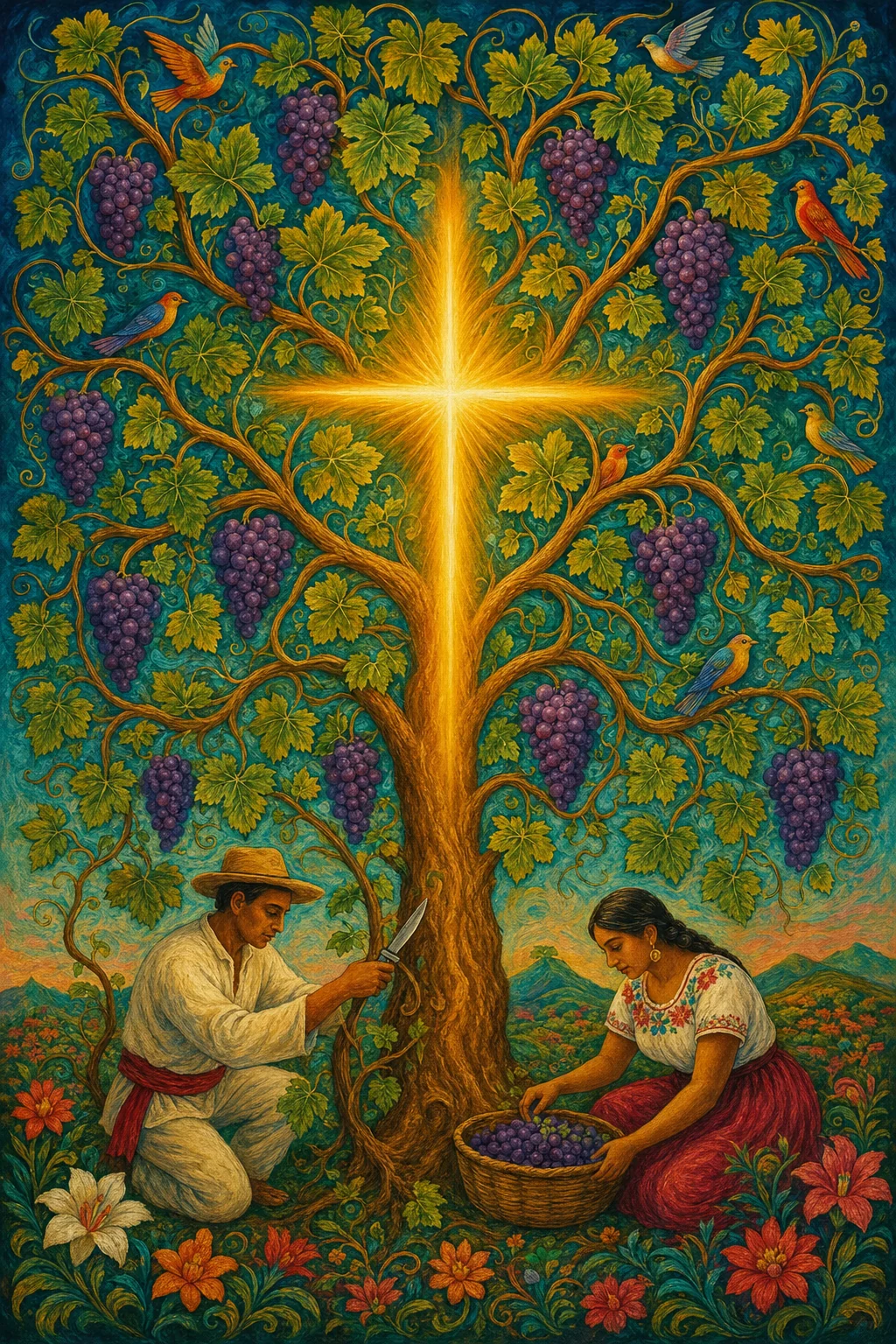
Jesus says that He is the vine and that those who stay in Him bear fruit. Painted in the spirit of Mexican folk painting, with vivid colour and small birds.
What Scripture says. In John, Jesus says that He is the true vine and His Father is the vinedresser, and that a branch cannot bear fruit unless it stays in the vine.
What the painter imagined. The grapes, the birds, the gold cross of light and the figures of the vinedresser and the gatherer are the painter's own. No figure of Christ is drawn: the vine is the picture He gave.
The tradition it speaks in. Folk painters of Mexico and Oaxaca use bright red, green, turquoise and gold in rhythmic leaves and flowers, and a crowd of small living things. This picture is made in that spirit as an original work.
How it was made and chosen. An original image made for The Living Bread with the gpt-image-2 model. It copies no older painting. The builder who chose it wrote: no figure of Christ, a gold cross of light in the vine, two workers. The other candidate, variant 1, was set aside because the cross is lost in the trunk; the other candidate reads at a distance.
Three paintings in the passage of witnesses
The passage between the halls carries three wider paintings. Two of them take the Basilica's own theme most directly, the Church gathered from every nation.
The Multitude Before the Lamb
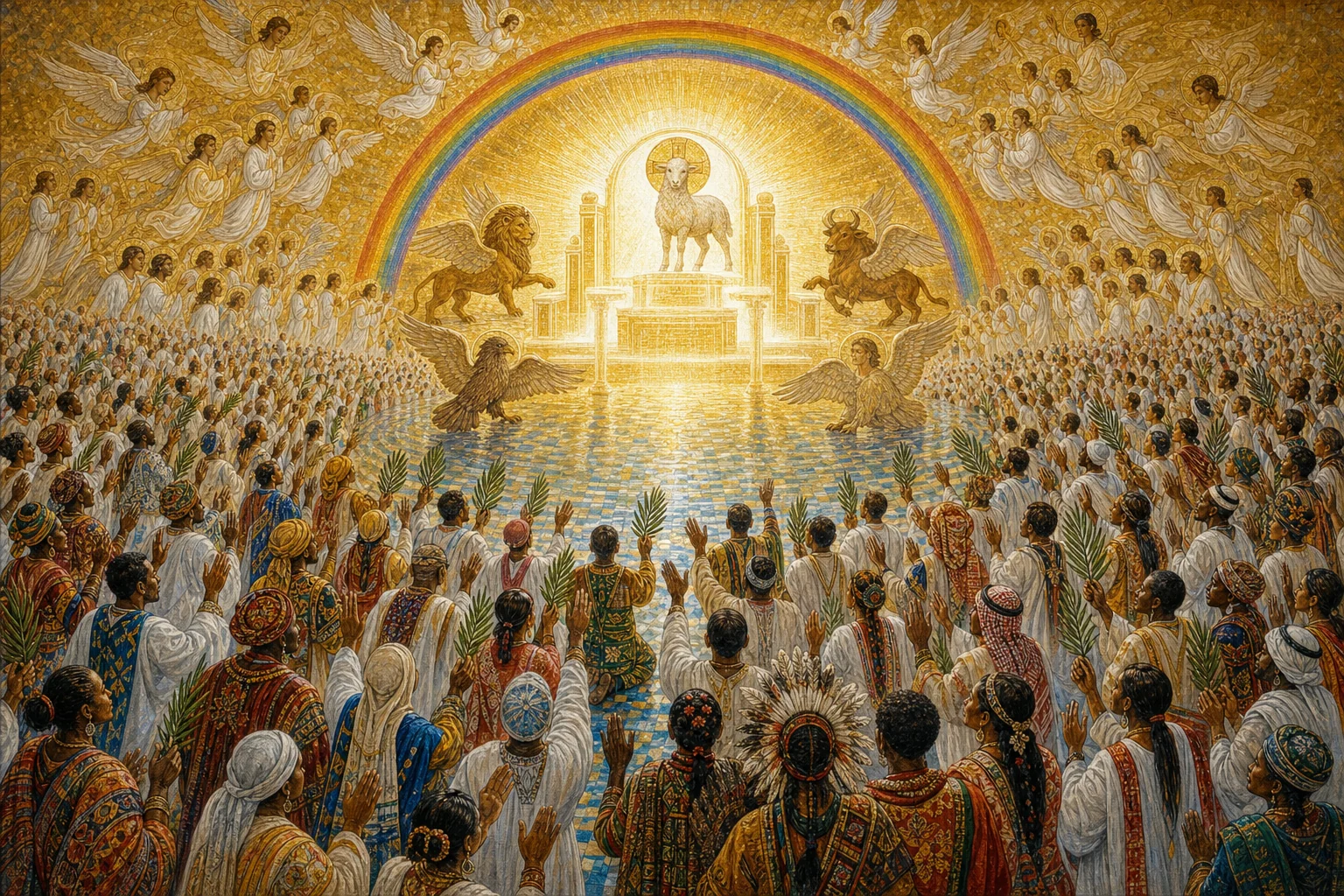
John sees a multitude from every nation, tribe and language standing before the Lamb. Painted in the manner of a gold mosaic, with textile patterns of Africa, Asia and the Americas.
What Scripture says. Revelation describes a great multitude no one could count, from every nation and tribe and people and language, standing before the throne and before the Lamb and crying out in praise.
What the painter imagined. The costumes, the arrangement of the crowd, the rainbow and the pattern of the throne are the painter's own. The throne is left empty of any figure, with only light, as the book describes a throne and not a face.
The tradition it speaks in. Gold mosaic is the oldest way the church has pictured heaven, because gold gives light that does not come from any lamp. The patterns in the robes are drawn from the cloth of many peoples, to say what the passage says, that the crowd is every nation. This picture is an original work.
How it was made and chosen. An original image made for The Living Bread with the gpt-image-2 model. It copies no older painting. The builder who chose it wrote: every nation, four living creatures, the Lamb on an empty throne, an Indigenous American headdress among the crowd. The other candidate, variant 1, was set aside because the throne is a stepped stage and the four living creatures are hard to tell apart; fewer nations visible in the front rows.
The Light on the Damascus Road
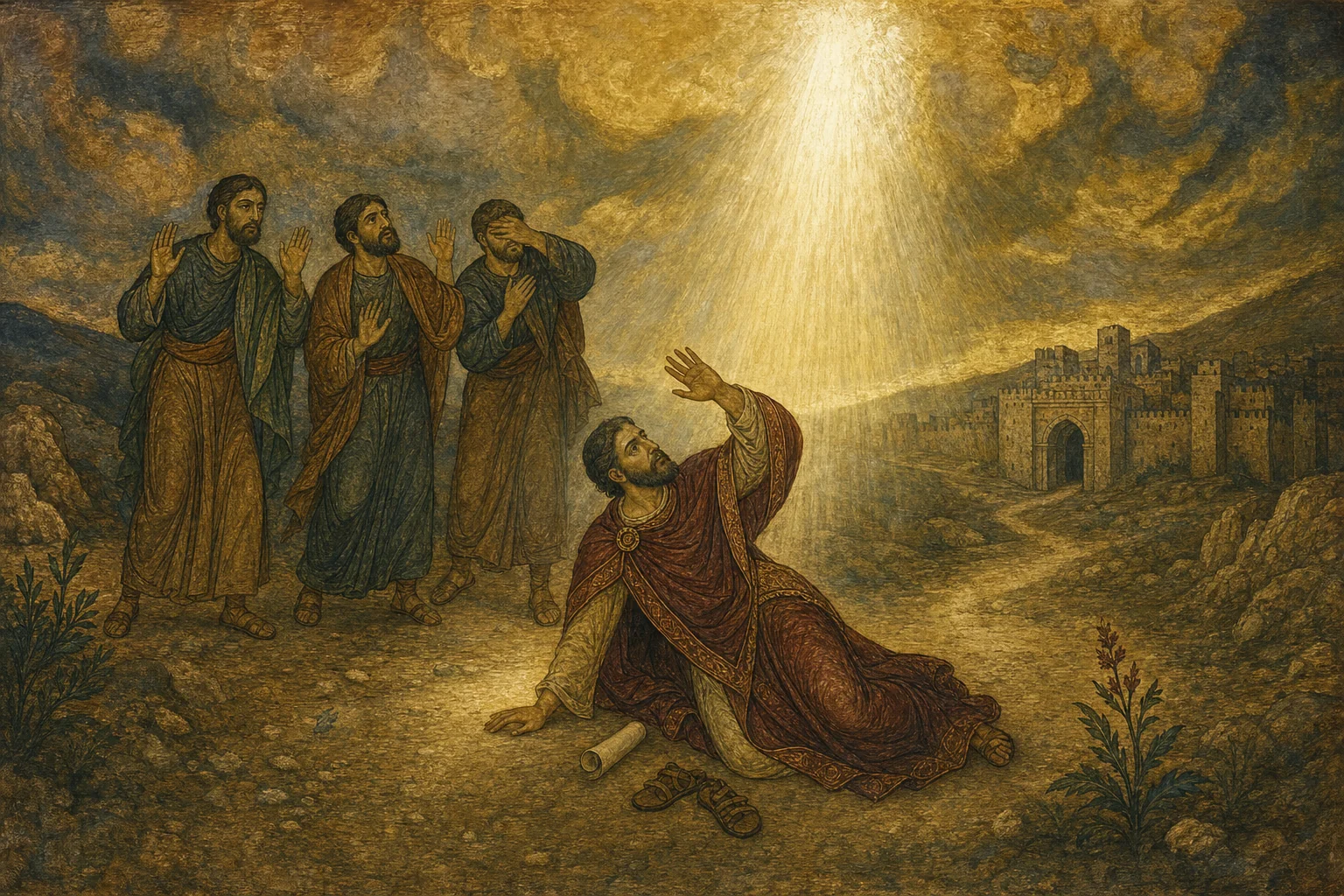
A man who was hunting the church is stopped by a light from heaven. Painted in the spirit of the medieval Georgian church frescoes of the Caucasus.
What Scripture says. Acts tells that Saul, on the road to Damascus, was surrounded by a light from heaven, fell to the ground and heard a voice, and that he was led into the city blind.
What the painter imagined. The road, the city gate, the cloak, the companions and the shape of the light are the painter's own. No figure is drawn in the light, because the passage speaks of a light and a voice.
The tradition it speaks in. Georgia is one of the oldest Christian nations, and its church painters worked in dark ochre and deep green with long solemn figures and fine outlines. This picture is made in that spirit as an original work.
How it was made and chosen. An original image made for The Living Bread with the gpt-image-2 model. It copies no older painting. The builder who chose it wrote: one fallen man, three companions, a shaft of light with no figure in it, scroll and sandals on the road. The other candidate, variant 1, was set aside because the shaft of light ends in an odd bird shaped cloud and the companions are crowded at the left edge.
The Fellowship of the First Believers
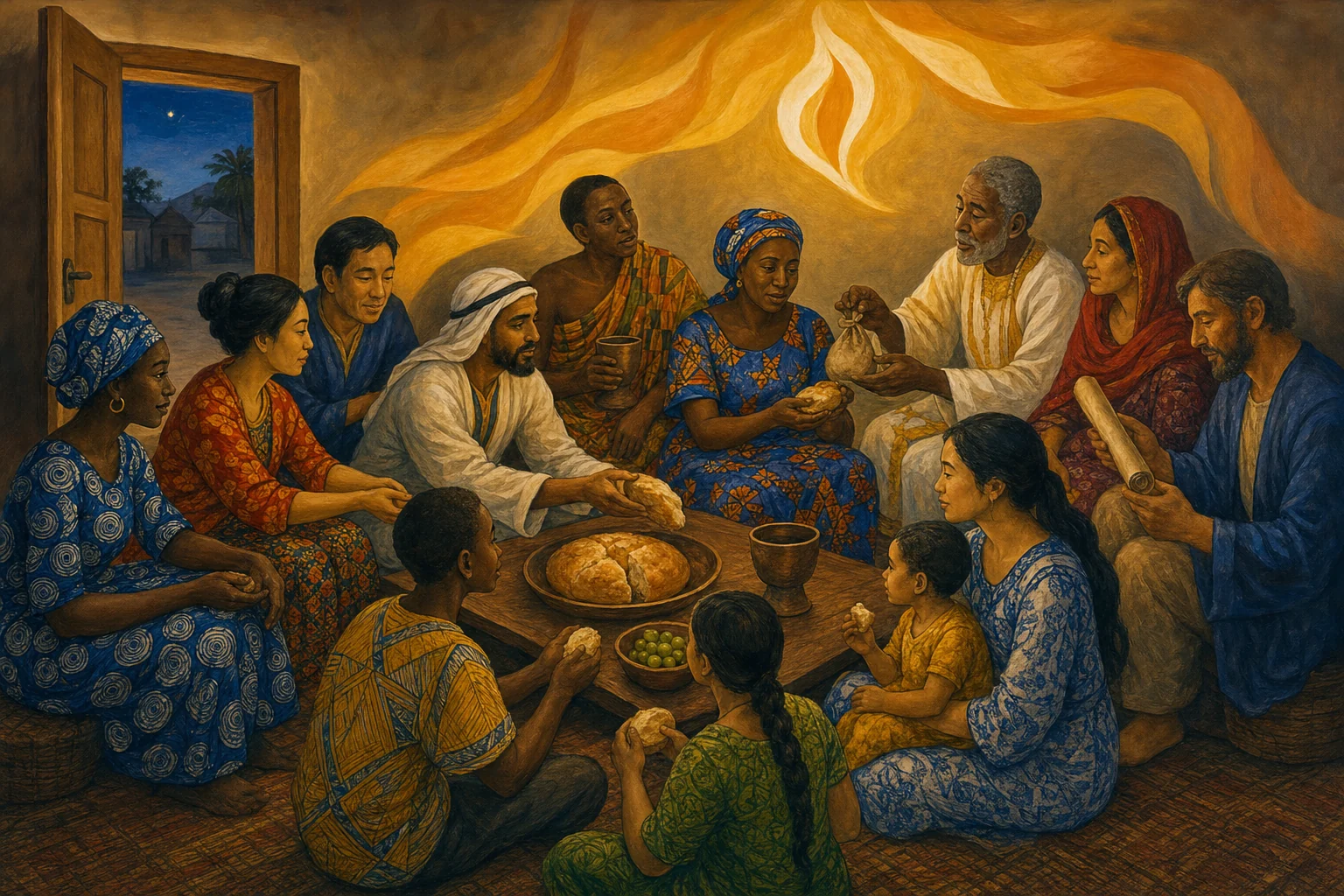
The first believers share bread, prayers and what they have. Painted in the spirit of contemporary African Christian murals, with bold shapes and patterned cloth.
What Scripture says. Acts tells that the first believers devoted themselves to the teaching of the apostles, to fellowship, to the breaking of bread and to prayer, and that they shared what they had with anyone in need.
What the painter imagined. The house, the table, the cloth, the number of people and the lamp light are the painter's own.
The tradition it speaks in. Churches across Africa paint their walls with bold flat shapes, warm earth and indigo, and cloth in many patterns. This picture is made in that spirit as an original work.
How it was made and chosen. An original image made for The Living Bread with the gpt-image-2 model. It copies no older painting. The builder who chose it wrote: people of many nations around a table, bread and cup, an elder giving, a child, a scroll; a man at the right edge is slightly cropped. The other candidate, variant 1, was set aside because fewer nations read at a glance and a man and the bowl are cropped at the bottom edge; the other candidate is clearer.
Two paintings at the Garden of Gethsemane
The garden holds the last two paintings, both from the week of the cross.
Christ Prays in the Garden
On the night before the cross, Jesus prays among the olive trees. Painted in the spirit of Byzantine and Romanesque sacred painting, in deep blue and gold.
What Scripture says. Luke tells that Jesus went to the Mount of Olives and prayed, that an angel from heaven appeared and strengthened Him, and that He found His disciples asleep.
What the painter imagined. The moon, the gnarled trees, the rock and the golden light are the painter's own. Christ is shown by the old conventions of sacred art and no likeness is claimed.
The tradition it speaks in. This picture hangs at the end of the stone path of the Garden of Gethsemane, where the walker is invited to sit awhile. It is an original work, made in the spirit of Byzantine and Romanesque painting.
How it was made and chosen. An original image made for The Living Bread with the gpt-image-2 model. It copies no older painting. The builder who chose it wrote: one Christ by convention, one angel, exactly three sleepers. The other candidate, variant 2, was set aside because only two sleeping disciples can be counted (the passage has three).
The King Comes Humbly to Jerusalem
Jesus rides down the Mount of Olives into Jerusalem while the crowd praises God. Painted in the spirit of Japanese gold ground screen painting.
What Scripture says. Luke tells that Jesus rode a colt down the Mount of Olives, that the disciples spread their cloaks on the road, and that the whole crowd began to praise God for all they had seen.
What the painter imagined. The gold clouds, the city, the crowd of many nations and the style of the drawing are the painter's own. Christ is shown by the old conventions of sacred art and no likeness is claimed.
The tradition it speaks in. Japanese painters set small elegant figures against flat gold clouds and bands of mist on folding screens. This picture borrows that way of drawing for a scene on the very hill where the garden of Gethsemane lies. It is an original work.
How it was made and chosen. An original image made for The Living Bread with the gpt-image-2 model. It copies no older painting. The builder who chose it wrote: Christ by convention only on a donkey, disciples, a crowd of many nations laying cloaks and palms, gold ground clouds, a walled city. The other candidate, variant 1, was set aside because the city carries a blue domed building from a later age, which the first century scene must not.
How Christ is shown, and why four are not pictured here
Christian art has long shown Christ by convention: a cross in the halo, a calm gaze, an open hand, and the Basilica says in each case that this claims no likeness, because none survives. Four of the seventeen paintings use that convention, the calling of the fishermen, the Good Shepherd, the prayer in Gethsemane and the entry into Jerusalem. They are described on this page and hang in the Basilica, but they are not reproduced here, because The Living Bread's own standing rule is that Christ is never depicted, and a decision on how that rule applies to a public web page belongs to the owner.
A walk along the wall, by tradition
Read in order the traditions are Ethiopian and Coptic, Andean and Mexican, Russian and Byzantine, Armenian and Syriac manuscript, Romanesque fresco, the murals of Kerala, Chinese ink and gold, Syriac Gospel manuscripts, the early Italian Renaissance, Korean ink wash, the catacombs of Rome, Mexican folk painting, gold mosaic with textiles of three continents, Byzantine and Romanesque blue and gold, the frescoes of medieval Georgia, contemporary African murals and Japanese gold ground screens. Some traditions, such as the Byzantine and the Syriac, recur in more than one picture, and none is placed above another.
See them hung
The paintings hang in the Basilica, with the Grand Hall's niches first. If your device cannot run the 3D walk, the Scripture references on this page open in the Bible reader.
Questions people ask
- Who painted these pictures?
- They are original images made for The Living Bread with an AI image model, gpt-image-2, and selected by hand. They are not by a named artist and they copy no older painting.
- Are the paintings copies of famous works?
- No. Each is painted in the spirit of a tradition, such as Ethiopian, Korean or Georgian church painting, and is an original composition. They are not copies.
- Why are there four paintings I cannot see on this page?
- Because they show Christ by long established convention, and The Living Bread's standing rule is that Christ is never depicted. They hang in the Basilica, and this page describes them instead.
- Do the paintings claim to show what people really looked like?
- No. The gallery's own notice says they are artistic interpretations and that no authenticated likeness of any person in them survives.
- Where do the paintings hang?
- Twelve hang in the niches of the Grand Hall of Saint Michael, three in the passage of witnesses and two at the Garden of Gethsemane.
- Can I reuse the images?
- The images are original works of The Living Bread and are not offered under a free license on this page. Ask before you reuse them.
The Word became flesh
Every person in Scripture is there because of the One the whole book is about. He said that we are to love one another as He loved us. Read a little each day, pray with someone, and ask Him to open the page.
Open the BibleGet the appAsk your honest questionsJesus Christ is Lord.
