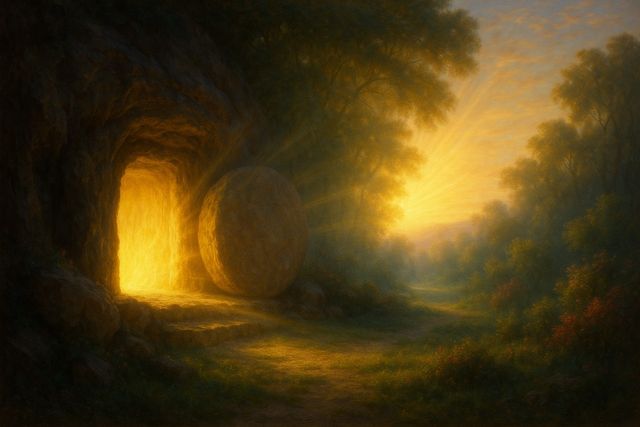
A garden of Scripture
The Garden of the Tomb
John alone notes that in the place where Jesus was crucified there was a garden, and in the garden a new tomb where no one had yet been laid. There they buried him in haste as the sabbath drew near. Three days later, in that same garden at dawn, weeping Mary would meet a man she took to be the gardener.
“Now in the place where he was crucified there was a garden; and in the garden a new sepulchre, wherein was never man yet laid.”John 19:41
The garden
The setting is a burial garden near Golgotha, close enough that the cross and the tomb share the same ground. A wealthy disciple, Joseph of Arimathea, owned the new sepulchre cut in rock, and there the body of Jesus was wrapped with spices and laid, a great stone rolled across the entrance. On the first day of the week, while it was yet dark, Mary Magdalene comes to the garden and finds the stone taken away. She stands outside the tomb weeping, certain that someone has stolen the body of her Lord. Through her tears she sees a figure standing in the early light and supposes him to be the keeper of the garden. It is a place of grief and stone, until a voice speaks her name and turns morning into the first morning of a new creation.
What happened here
In the dawn Mary turns and sees Jesus, but does not know him, and thinks the gardener has moved the body. She pleads to be told where he is laid. Then he says one word, her name, Mary, and everything changes. She turns fully and answers, Rabboni, and reaches to hold him, but he tells her not to cling, for he must ascend to the Father. He sends her to the disciples as the first witness of the resurrection, the first to carry the news that death is undone. What looked like the end of a story, a corpse and a sealed grave, becomes the hinge of history. The tomb is empty, the linen folded, and the garden that held a burial now holds the risen Lord.
How it points to Christ
That Mary mistook Jesus for the gardener is a mistake full of truth. In Eden a gardener was set over a garden and lost it through sin. Now the true Gardener stands in a garden at first light, having conquered the death that Eden's fall let in. Paul writes that as in Adam all die, so in Christ all are made alive, and here that new life breaks into the world. The resurrection is the beginning of the new creation, the reversal of the curse worked not in theory but in a living body that walks and speaks and calls the grieving by name. Where the first garden ended with expulsion and a guarded tree of life, this garden begins with welcome, and the risen Christ becomes himself the firstfruits of all who will rise.
Questions people ask
Why did Mary Magdalene think Jesus was the gardener?
It was still early and dim, her eyes were blurred with tears, and she had no expectation of seeing him alive. In a burial garden, a man at work would naturally seem to be its keeper. John records the detail plainly, yet many readers hear a deeper echo, for the risen Christ truly is a gardener of sorts, tending the first sprout of a new creation.
Where was Jesus buried?
John says the tomb lay in a garden near the place of crucifixion, in a sepulchre freshly cut from rock and never used, owned by Joseph of Arimathea. The nearness mattered, for the sabbath was pressing and the burial had to be swift. Two traditional sites are honored in Jerusalem today, though the exact spot is uncertain. What Scripture stresses is that the grave was real, and then empty.
Why is it meaningful that the resurrection happened in a garden?
Scripture keeps returning to gardens at its turning points. Humanity fell in a garden, Jesus surrendered in a garden, and he rose in a garden. The pattern is not accidental but poetic, God retelling the story of Eden and mending it. The empty tomb in a garden signals that the long undoing of the curse has begun, and that creation itself will one day bloom again.
