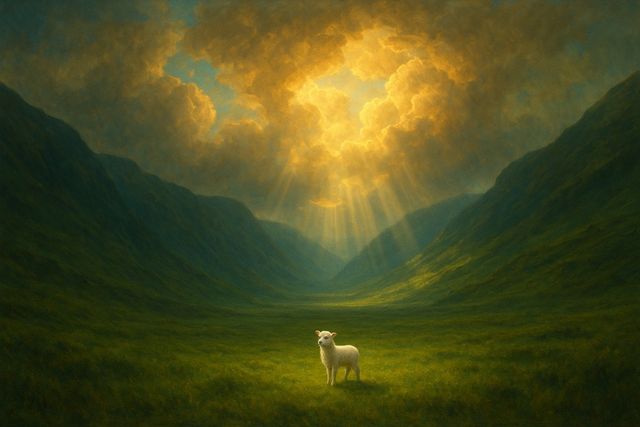
One shepherd, and the Good Shepherd
The Shepherds at Bethlehem
When the greatest news the world would ever hear was finally announced, it did not go first to a palace or a temple. It went to shepherds in a field outside Bethlehem, ordinary men keeping watch through the night over their flock. The choice of audience is not incidental. Luke records it with care, and readers have pondered ever since why the birth of the Savior was proclaimed first to people at the edges of respectable society. There is a quiet fittingness here that the cluster on the shepherds of the Bible cannot miss. The one being announced would call himself the good shepherd. And the first to hear of his coming were shepherds, watching their sheep by night as he would one day watch his flock. The news of the Shepherd-Savior came first to shepherds, and that pairing carries its own gentle sermon.
“And there were in the same country shepherds abiding in the field, keeping watch over their flock by night.”Luke 2:8
The shepherd in Scripture
Luke sets the scene with deliberate simplicity in the second chapter of his Gospel. After recording the birth of Jesus in Bethlehem, laid in a manger because there was no room, he turns to the countryside nearby. In that region shepherds were staying out in the fields, keeping watch over their flock by night. The detail of Luke 2:8 is spare but vivid. These are working men on the night shift, awake while others sleep, doing the unglamorous labor of guarding animals in the dark. Into that ordinary night the extraordinary breaks in. An angel of the Lord stands before them, and the glory of the Lord shines around them, and they are terrified. The messenger tells them not to fear, for he brings good news of great joy for all the people. Then comes the announcement itself, that this day in the city of David a Savior has been born, who is the Messiah, the Lord. They are given a sign, that they will find a baby wrapped in cloths and lying in a manger. Suddenly the single angel is joined by a great company of the heavenly host, praising God and speaking of glory to God in the highest and peace on earth. Then the angels depart, and the shepherds are left in the dark field with what they have heard. They decide at once to go to Bethlehem and see this thing that has happened, and they hurry off and find Mary and Joseph and the child lying in the manger, just as they were told. Having seen, they do not keep it to themselves. Luke says they made known what had been told them about this child, and all who heard were amazed. Mary treasured these things and pondered them in her heart. The shepherds return to their flock, glorifying and praising God for everything they had heard and seen. The passage moves in a full circle, from the field to the manger and back to the field, but the men who return are not the same as those who left. They go back as the first witnesses and the first proclaimers of the birth of the Savior.
What it comes to mean
The most striking thing about this passage is the audience God chose. Shepherds were not among the powerful or the prominent. Theirs was hard, low-paid outdoor work, and in the social world of the time they occupied a humble place. Yet the announcement of the Savior's birth came to them first, before the learned or the mighty, before Jerusalem heard anything. Luke does not comment on this directly, but the choice speaks. The good news is aimed, from its very first hour, at people the world overlooks. There is also a fittingness in shepherds hearing it. Bethlehem was the city of David, and David had been a shepherd boy there before he was a king. To announce a Savior in David's city to men doing David's old work is to weave the new story into the old. The setting quietly recalls that God had a history of taking shepherds and making them into something more, and now the greatest of David's line was being born where David once kept sheep. Honesty requires noting what the text does and does not say. Luke does not explicitly explain why shepherds were chosen, and readers should resist over-reading the point. The passage does not say shepherds were despised outcasts in every sense, only that they were ordinary working men on a night watch. The force of the scene comes not from a heavy theological label but from the plain contrast between the enormity of the news and the humbleness of its first hearers. The shepherds' response is its own lesson. They do not merely hear and marvel. They go, they see, and then they tell. Luke traces a movement from receiving the word to acting on it to spreading it, so that the first hearers become the first proclaimers. Ordinary men, entrusted with astonishing news, do not sit on it. They make it known, and they return to their ordinary work glorifying God. The pattern of hearing, seeing, and telling is the whole shape of witness in miniature. Finally, the passage frames the birth as good news of great joy for all the people. The announcement to shepherds is not a narrowing but a beginning. It comes first to the humble precisely because it is meant for everyone, and the lowly field is where the universal joy is first sounded. What begins with a few tired men in the dark is announced as belonging to all.
How it points to Christ, the good shepherd
The child announced to the shepherds would grow up to call himself the good shepherd, the one who lays down his life for the sheep. Luke does not draw the line explicitly here, but the resonance is unmistakable within the wider story of the Gospels. The Shepherd-Savior was proclaimed first to shepherds, as if the announcement itself hinted at what kind of Savior he would be, one who knows the labor of watching over a flock through the night. The scene gathers up the whole theme of this cluster. Across the Scriptures God is the shepherd of his people, and he had promised one shepherd to come. In Bethlehem, the city of the shepherd-king David, that promise takes on flesh, and the first to be told are men holding a shepherd's staff. The imagery converges on the manger. The one who will seek the lost and carry them home is here announced to those who spend their nights seeking and guarding sheep. This is offered as a fittingness rather than a proof. Luke's plain report is that shepherds heard first and went and told. Christians reading the fuller Gospel see in that choice a foreshadowing of the Shepherd he would be, humble in his coming, near to the overlooked, and destined to gather a flock of his own. The field outside Bethlehem becomes the first place where the good news of the good Shepherd is spoken and believed.
Questions people ask
Why were the shepherds the first to hear of Jesus' birth?
Luke does not state the reason directly, but the choice speaks. Shepherds were ordinary working men on a night watch, humble in the social world of the time. The announcement of a Savior for all people came first to the overlooked, and it came fittingly near Bethlehem, the city of David, who had himself been a shepherd there.
What did the shepherds do after they heard the announcement?
They went at once to Bethlehem, found Mary and Joseph and the child in the manger just as they were told, and then made the news known to others, who were amazed. Afterward they returned to their flock glorifying and praising God, becoming the first witnesses and the first to proclaim the birth of the Savior.
