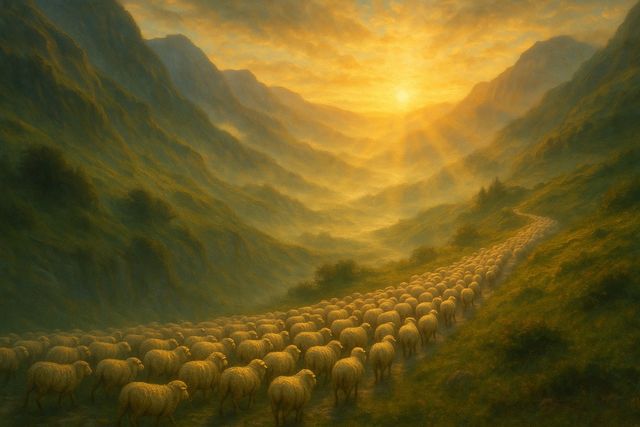
One shepherd, and the Good Shepherd
Jacob the Shepherd
We remember Jacob for many things: the stolen blessing, the ladder at Bethel, the wrestling by the Jabbok, the twelve sons who become the tribes of Israel. Less often do we remember that for twenty years he was a working shepherd, rising before dawn and lying down under open sky, guarding another man's flocks in a foreign land. Yet it was in those long years of labor that much of his character was formed. One verse in particular lets Jacob speak for himself about that work. In it he describes the true cost of faithful shepherding, the heat and the cold, the sleepless nights, the losses he bore himself. It is one of the most honest pictures of a shepherd's life in all of Scripture, and it opens a window onto what it means to give oneself for a flock.
“Thus I was; in the day the drought consumed me, and the frost by night; and my sleep departed from mine eyes.”Genesis 31:40
The shepherd in Scripture
The words come near the end of Jacob's time with his uncle Laban, recorded in Genesis chapter 31. Jacob had fled to Haran years before, and there he had met Rachel at a well and agreed to serve seven years for her. Laban deceived him, giving Leah first, and Jacob served another seven years for Rachel, and then longer still for wages in flocks. Over those two decades he tended Laban's sheep and goats, and Laban changed his wages many times. When at last Jacob departs, Laban pursues and overtakes him, and the two men confront each other. In the course of his defense Jacob lays out what his service had actually been. In Genesis 31:38 and following he reminds Laban that in all those years the ewes and she goats had not miscarried under his care, and that he had not eaten the rams of Laban's flock for himself. Whatever was torn by beasts he did not bring to Laban to share the loss; he bore it himself, and Laban required it of his hand whether it was stolen by day or by night. Then comes the verse that captures the whole burden. In Genesis 31:40 Jacob says that in the day the drought consumed him, and the frost by night, and his sleep departed from his eyes. The single sentence gathers up years of hardship: the burning heat of the wilderness days, the biting cold of the desert nights, and the wakefulness of a man who cannot rest because the flock never stops needing him. He does not exaggerate; the shepherd's world was exactly this exposed. Jacob goes on to say that he served Laban fourteen years for his two daughters and six years for the flocks, twenty years in all, and that Laban had changed his wages ten times. He declares that were it not for the God of his father, the God of Abraham and the Fear of Isaac, Laban would have sent him away empty. God had seen his affliction and the labor of his hands, and had rendered judgment. The speech is a shepherd's account of loss borne, risk absorbed, and rest surrendered, offered as evidence of a faithful service that only God had finally rewarded.
What it comes to mean
Taken plainly, the passage is Jacob's defense of his own integrity as a hired shepherd. He states that he never used his master's animals for his own comfort, that he covered losses that were not his fault, and that he endured extreme conditions without relief. The stated point is that Jacob served faithfully and at real cost, and that Laban had repeatedly shortchanged him. This is honest testimony, not a sermon, and we should first hear it as such. Drawn out a little further, the verses give us one of Scripture's clearest anatomies of what shepherding demanded. The good shepherd of the ancient world did not merely own animals; he lived exposed to everything they were exposed to, and more. He stood between the flock and the predator, between the flock and the weather, between the flock and the thief. When an animal was torn, the loss came out of the shepherd's own account. The care was total, and it was costly in the shepherd's own body and rest. There is also a fair and honest tension in Jacob's story that we should not smooth over. This same man had been a schemer, a supplanter who took his brother's blessing by deceit, and even in his dealings with Laban's flocks he used clever means to increase his own herds. Scripture does not present Jacob as a flawless saint. Yet through twenty years of grinding labor, God was at work, disciplining and shaping a self-reliant man into Israel, one who would limp away from Peniel leaning on God rather than on his own cunning. So the meaning the text plainly states, faithful and costly service vindicated by God, sits alongside a meaning we may rightly draw: that God uses long, hard, unglamorous work to form his people. The years Jacob spent watching over another's flock in drought and frost were not wasted years. They were the school in which a grasping man learned endurance, responsibility, and dependence on the God who saw his affliction.
How it points to Christ, the good shepherd
Jacob's description of the shepherd who bears every loss himself points forward, gently but truly, to Christ. Jesus draws on exactly this picture when he calls himself the good shepherd who lays down his life for the sheep, contrasting himself with the hireling who flees when the wolf comes. Jacob was no hireling in spirit; he absorbed the losses that a mere hired hand would have refused. In that faithfulness he foreshadows the Shepherd who would absorb not merely the loss of torn animals but the sin and death of his whole flock. The heat by day and frost by night, the sleep that departed from Jacob's eyes, sketch the shape of a self-giving that Christ would fill to the full. Our Lord had nowhere to lay his head, watched through the night in Gethsemane while his disciples slept, and gave himself entirely for those the Father had given him. Where Jacob endured hardship and was rewarded with flocks and family, Jesus endured the cross and was given a people gathered from every nation, his own flock forever. We should not press the parallel further than Scripture allows; Jacob is a flawed man serving for wages, not a sinless Savior. Yet the pattern he lived is the pattern Christ perfected. Faithful shepherding costs the shepherd everything and covers the loss the sheep could never cover themselves. When we read Jacob's weary words, we are looking at a true, human sketch of the love that would one day lay down its life and take it up again for the sheep.
Questions people ask
How long did Jacob work as a shepherd for Laban?
By his own account in Genesis 31, Jacob served Laban twenty years in all: fourteen years for his two daughters, Leah and Rachel, and six more years for wages in flocks. During that time he says Laban changed his wages ten times, and only God's intervention kept him from being sent away empty-handed.
What does Genesis 31:40 tell us about ancient shepherding?
It shows how exposed and demanding the work was. Jacob endured scorching heat by day and freezing cold by night, and lost sleep guarding the flock. He also bore the losses himself when animals were torn or stolen. The verse is one of Scripture's most honest pictures of the shepherd's costly, self-giving labor.
