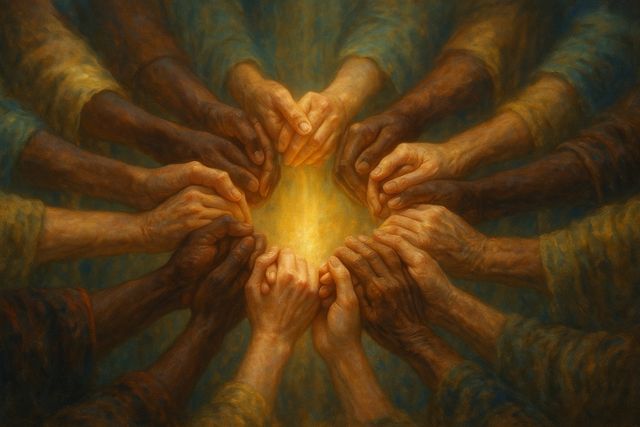
A question God asked, and still asks
What Is That in Your Hand?
Moses is standing before a bush that burns without being consumed, and he is running out of excuses. He has told God the people will not believe him, that he is not the man for this, that someone, anyone, else would do. In the middle of his protests God asks him a small and disarming question. What is that in your hand? Moses looks down. It is only his staff, a shepherd's stick, the most ordinary object in his life. He has leaned on it for forty years. And God is about to make it the instrument of a nation's deliverance. The question still finds us in our own moments of excuse, when we are convinced we have nothing to offer, when we are staring at the burning invitation of God and reaching for reasons to walk away.
“And the LORD said unto him, What is that in thine hand? And he said, A rod.”Exodus 4:2
“And he said, Cast it on the ground. And he cast it on the ground, and it became a serpent; and Moses fled from before it.”Exodus 4:3
Where He asks it
The scene is the far side of the wilderness, near Horeb, the mountain of God. Moses, once a prince of Egypt, is now a fugitive tending his father-in-law's sheep. A bush blazes without burning up, and from it God calls him to go back to Egypt and lead His people out of slavery. Moses is full of objections, chief among them the fear that no one will believe God has appeared to him. In answer God does not deliver a lecture. He asks what Moses is holding. Moses names it: a staff. God tells him to throw it on the ground, and it becomes a serpent; He tells him to take it up again, and it is a staff once more. The plain shepherd's rod becomes the sign, and later the very rod that will part a sea.
What the question is really doing
God is not curious about Moses' equipment. The question redirects Moses' whole way of seeing. Moses is looking outward, certain that the mission requires resources he does not have, credentials he lost, powers he was never given. God turns his eyes to what is already in his grip. The point is not the staff. The point is that God delights to work through the ordinary thing we already carry, the skill we dismiss, the small history in our hands. He does not wait for us to become impressive. He asks what is already there and then breathes His power into it. The question dismantles the excuse that we have nothing to offer, because the offering was never meant to be ours alone. It was meant to be ours, surrendered, and His.
How this question leads to Christ
God's habit of using small things in ordinary hands reaches its height in Christ. A boy's few loaves and fish, placed in Jesus' hands, feed thousands. A widow's two coins become the measure of true giving. And Christ Himself comes not with the staff of empire but with the wood of a carpenter and finally the wood of a cross, the most ordinary instrument of Roman death turned into the throne of the world's redemption. He asks His followers the same question still. What is in your hand? A little bread, a little time, a willingness others would overlook. He does not despise the smallness of what we bring. He takes it, blesses it, breaks it, and gives it back multiplied. The kingdom does not run on our sufficiency. It runs on what we surrender.
Questions people ask
Why did God use a staff instead of giving Moses something new?
Because the lesson was about surrender, not supply. God wanted Moses to see that deliverance would not come from powers Moses acquired but from ordinary things placed in God's hands. Starting with the familiar staff made the miracle personal. It said the God who called him would work through his actual life, not a borrowed one.
What if what's in my hand really does feel too small?
It almost always will, and that is rather the point. The loaves were too few, the coins too small, the staff too plain. Smallness is not disqualification; it is the usual raw material of God's work. He is not asking whether your offering is enough. He is asking whether you will hand it over and let Him do what only He can.
