One throne, and the King upon it
The Lamb in the Midst of the Throne
After John is shown the throne and the One seated upon it, a search begins in heaven for someone worthy to open a sealed scroll. No one is found, and John weeps. Then he is told to stop weeping, for the Lion of the tribe of Judah has prevailed. He turns to look for a lion, and instead he sees a Lamb, and the Lamb bears the marks of having been slain. This is the astonishing center of the vision, and indeed of the whole book. The One who reigns at the center of everything is disclosed as a slaughtered Lamb who lives. Power and sacrifice, the throne and the wounds, are not held in different places. They occupy the same seat. The most exalted position in all reality belongs to the One who was killed, and he holds it precisely as the One who was killed.
“And I beheld, and, lo, in the midst of the throne and of the four beasts, and in the midst of the elders, stood a Lamb as it had been slain, having seven horns and seven eyes, which are the seven Spirits of God sent forth into all the earth.”Revelation 5:6
“For the Lamb which is in the midst of the throne shall feed them, and shall lead them unto living fountains of waters: and God shall wipe away all tears from their eyes.”Revelation 7:17
The throne in Scripture
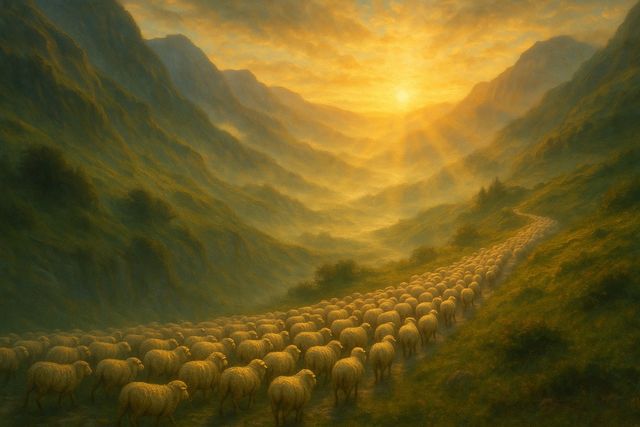
Revelation 5:6 places the figure with striking precision. John sees a Lamb standing in the midst of the throne, among the living creatures and the elders, and the Lamb appears as though it had been slain. The word for slain is a sacrificial term, the language of a victim killed in offering. Yet the Lamb stands, alive and upright, bearing the wounds of death while plainly living. The scars are not hidden. They are the mark by which he is known. The location is deliberate and central. He is in the midst of the throne, at the very heart of the scene John has been describing. This is not a lesser figure standing before the throne at a respectful distance. The Lamb occupies the center that chapter 4 had reserved for the One who created all things. When the Lamb takes the scroll in verse 7, the entire company of heaven responds with worship, falling down before him with harps and bowls of incense, singing that he is worthy because he was slain and by his blood redeemed people from every tribe and tongue. The worship offered to the Lamb is the same worship offered to the One on the throne. By the end of chapter 5 the innumerable multitude sings to the Lamb the honor and glory and power that belong to God, and finally every creature in heaven and earth blesses both the One seated on the throne and the Lamb together, in a single breath of praise. The vision draws no line between them in worth. They receive worship as one. The image returns near the end of John's vision with a tender addition. Revelation 7:17 says that the Lamb who is in the midst of the throne shall feed his people and lead them to living fountains of waters, and that God shall wipe away every tear from their eyes. Here the same central Lamb is a shepherd. The One at the heart of the throne, marked by his own death, tends the redeemed as a shepherd tends a flock, guiding them to water and comforting them. The reigning Lamb and the shepherding Lamb are one and the same.
What it comes to mean
The plain statement of the text is extraordinary enough on its own. In the midst of the throne stands a Lamb bearing the wounds of slaughter, alive, receiving the worship of all heaven. This is not drawn out by interpretation. It is what John reports seeing. The interpretive weight lies in taking the image seriously rather than softening it. What may be carefully drawn from it is a whole vision of what power at the center of reality actually looks like. John is told to expect a Lion and shown a Lamb. The prevailing of the Lion is accomplished by the slaying of the Lamb. The vision redefines conquest. Victory at the throne is won not by destroying enemies through force but by being slain and rising. This is an inference, but the text presses it directly, since the reason given for the Lamb's worthiness is precisely that he was slain and by his blood redeemed a people. The union of the throne and the wounds also teaches that the exaltation of Christ does not erase his sacrifice. The Lamb is glorified as the slain one. His scars are not overcome and forgotten but carried into glory as the very ground of his worthiness. Whatever else the redeemed will see at the center of heaven, they will see the marks of the death that redeemed them. The sacrifice is permanent in its honor. The shepherd image in chapter 7 keeps this reign from becoming cold or distant. The same Lamb who holds all authority stoops to feed and guide and comfort. Authority and tenderness are held in one figure. The One who could command the universe chooses to lead the thirsty to water and to wipe their tears. This is stated plainly in the text and needs no straining to see. Honesty requires noting the paradox rather than dissolving it. A Lamb standing yet slain, a Lion that conquers by being killed, a center of infinite power occupied by a sacrificial victim, these are not tidy propositions. The vision means to arrest the reader. It resists reduction to a formula. What it asks is not that we explain the paradox away but that we worship the One in whom it holds.
How it points to Christ, seated on the throne
This page is about Christ without disguise, for the Lamb is Christ, and the text makes the identification explicit. John the Baptist had already named Jesus the Lamb of God who takes away the sin of the world in John 1:29. The song of the redeemed in Revelation 5:9 names the ground of the Lamb's worth as his blood shed to redeem people from every nation, which is the language of the cross. The slain Lamb in the midst of the throne is the crucified and risen Jesus. Here the whole cluster of throne images finds its center. The throne set in heaven, the mercy encircling it, the holiness before which prophets tremble, all converge on this one figure. The One seated at the center of reality is the One who was crucified. Paul writes explicitly in Philippians 2 that because Christ humbled himself to death on a cross, God highly exalted him and gave him the name above every name. The path to the central throne ran through the slaughter of the Lamb. So the answer to the question of who reigns is not an abstraction or a distant sovereign. It is the Lamb who was slain, now standing in the midst of the throne, shepherding his people and leading them to living water. To worship at the center of heaven is to worship him, and to know him is to know that the marks of his sacrifice will never be hidden from those he saved.
Questions people ask
How can the Lamb be described as slain yet standing and alive?
The vision deliberately holds both together. The Lamb bears the marks of sacrificial death while standing upright and living, which pictures the crucified and risen Christ. His wounds are not hidden but are the very reason given for his worthiness. The image means to show that his sacrifice and his living reign belong to the same person.
Is the Lamb worshiped as God in this vision?
Yes. By the end of Revelation 5 the whole of creation blesses the One on the throne and the Lamb together in a single act of praise, and the Lamb receives the honor, glory, and power that belong to God. The vision draws no distinction in worth between them, presenting the Lamb as the proper object of the worship due to God alone.
