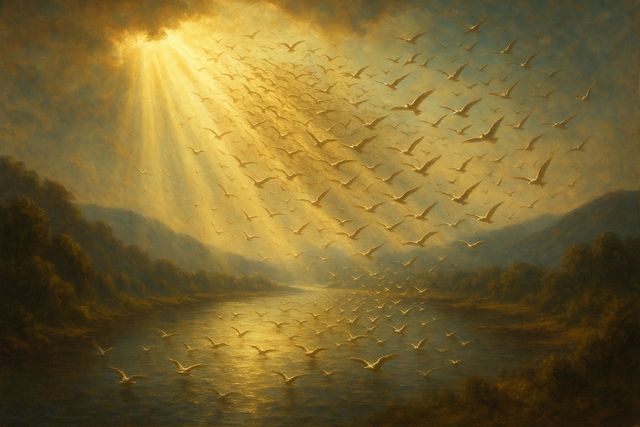
A window on the Spirit
The Dove
The dove is perhaps the most tender image of the Holy Spirit in all of Scripture. It descends upon Jesus at His baptism, gentle and unhurried, and marks Him out as the beloved Son on whom the Spirit rests.
“And Jesus, when he was baptized, went up straightway out of the water: and, lo, the heavens were opened unto him, and he saw the Spirit of God descending like a dove, and lighting upon him:”Matthew 3:16
The image in Scripture
The image in Scripture. The dove belongs above all to the baptism of Jesus. Matthew tells us, "And Jesus, when he was baptized, went up straightway out of the water: and, lo, the heavens were opened unto him, and he saw the Spirit of God descending like a dove, and lighting upon him" (Matthew 3:16). All four Gospels bear witness to it, and John records that this descending Spirit was the sign given to the Baptist by which he would know the Christ (John 1:32-33). The Spirit does not merely flit past; He comes and abides. Behind the scene stands an older echo. When the flood of judgment was spent, Noah sent forth a dove, and she returned with an olive leaf, a token that the waters had subsided and a new world was ready (Genesis 8:11). Some readers also hear the Spirit "moving upon the face of the waters" at creation (Genesis 1:2), brooding over the deep. The dove thus carries the fragrance of peace after judgment and of new creation quietly beginning.
What it teaches about the Spirit
What it teaches about the Spirit. The dove speaks of the Spirit's gentleness and purity. He is holy, and He does not force His way with violence but rests where He is welcomed. Jesus Himself calls His followers to be "harmless as doves" (Matthew 10:16), and the dove was among the offerings of the poor and the clean (Leviticus 12:8; Luke 2:24), so the image gathers up innocence and acceptable sacrifice. Yet gentleness is not weakness. The same Spirit who descends as a dove will drive Jesus into the wilderness to face the tempter (Mark 1:12), and the peace He brings is the peace that follows a real reckoning with sin, as the returning dove of Noah announced dry ground after the deluge. So the dove teaches that the Spirit brings rest, cleansing, and the dawn of a new creation in those He touches. Like every symbol, the dove illuminates one true facet of the Spirit's person without exhausting Him; He is far more than any single picture can hold.
How the Spirit glorifies Christ
How the Spirit glorifies Christ. Jesus said of the Spirit, "He shall glorify me: for he shall receive of mine, and shall shew it unto you" (John 16:14). The dove at the Jordan does exactly this. The Spirit descends not to draw eyes to Himself but to point to the One standing in the water, and the Father's voice answers, "This is my beloved Son, in whom I am well pleased" (Matthew 3:17). The whole scene is a spotlight on Christ. The Spirit anoints Jesus for His mission, marks Him as the sinless Lamb whom the waters cannot condemn, and identifies Him for a watching prophet and a watching world. When the Spirit rests upon a believer today with that same dovelike gentleness, He is still doing this one glad work, turning the heart toward Jesus and settling it in the Father's love.
Questions people ask
Does the dove mean the Holy Spirit is weak or passive?
No. Gentleness in Scripture is strength under control. The same Spirit who descended as a dove led Jesus to confront Satan in the wilderness and raised Him from the dead (Romans 8:11). The dove speaks of holiness and peace, not of powerlessness.
Why a dove and not some other bird?
The text does not fully explain the choice, so we should not press it beyond what is written. Yet the dove already carried rich associations in Israel's story: Noah's dove announcing peace after judgment, and the clean, humble offering of the poor. These fit the Spirit who brings new creation and rests on the spotless Son.
Was the Holy Spirit only given to Jesus at His baptism?
The Spirit had always been at work, and Jesus was conceived by the Spirit (Luke 1:35). The baptism was a public anointing and sign that marked the beginning of His ministry, not the first moment the Spirit was present with Him.
