The world behind the words
I Am the Good Shepherd
I am the good shepherd, Jesus said, and the good shepherd lays down his life for the sheep. Centuries of gentle stained glass have left us a soft image, a serene man in clean robes cradling a fluffy lamb, and we read the saying as a comforting picture of tenderness. Comfort is there, but the words were sharper than we remember. Shepherding in Jesus' world was hard, dangerous, low-status work, and He set it against a backdrop of hired hands who ran when trouble came and thieves who climbed into the fold to steal and kill. To call Himself the good shepherd was not first a claim about warmth. It was a claim about willingness to die, spoken to people who knew exactly what a real shepherd risked.
“I am the good shepherd: the good shepherd giveth his life for the sheep.”John 10:11
“I am the good shepherd, and know my sheep, and am known of mine.”John 10:14
The world behind the words
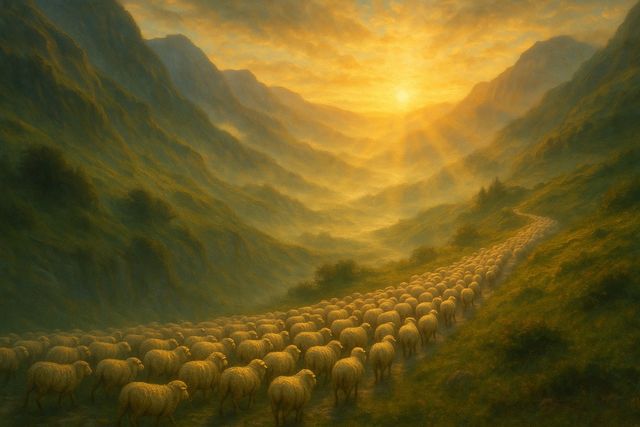
The world behind the words: a Judean shepherd led his flock across rocky, thinly grassed hill country, often far from home, sleeping outdoors among predators. At night the sheep were gathered into a fold, a rough stone enclosure with a single opening, and the shepherd would lie down across that gap so that no sheep could wander out and no wolf or thief could enter without passing over his own body. He truly became the door. Wolves, lions, and bandits were genuine threats, and defending the flock could cost a shepherd his life. A hired hand, paid to watch sheep he did not own, had every reason to flee when the danger arrived. The animals were not his, and neither was the risk worth his neck.
What Jesus was really saying
What Jesus was really saying: He is not a hireling minding a flock for wages, but the owner who loves the sheep as His own and will spend His very life to keep them. The contrast is deliberate and pointed at the religious leaders of His day, shepherds of Israel who fed themselves and scattered the flock. Jesus knows His sheep by name and they know His voice, an intimacy no employee has with borrowed animals. And where the hired hand calculates that no wage is worth dying for, Jesus reverses the math entirely. He does not merely risk His life reluctantly in an emergency. He lays it down freely, on purpose, as the very heart of what it means for Him to be good.
How it points to Christ
How it points to Christ: the saying is one of the great I am statements of John's Gospel, echoing the divine name spoken to Moses. The good shepherd is God Himself come to gather a scattered people. He becomes the door of the fold, lying across the gap so that all who enter through Him are saved, and He takes the wolf's fangs into His own body at the cross. No one takes His life from Him, He says, He lays it down of His own accord, and He has power to take it up again. That is the resurrection folded into the promise. He does not lose a single sheep to the thief who came to kill. He dies, He rises, and He carries the flock home on shoulders that bear the marks of the fight.
Questions people ask
How did a shepherd become the door of the sheepfold?
Many folds had only an open gap, no gate, so at night the shepherd literally lay down across the opening. Nothing could enter or leave except over his body. This everyday practice illuminates Jesus' related claim to be the door of the sheep, though He applies both images to Himself.
What is the difference between the shepherd and the hired hand?
Ownership and love. The hired hand watches sheep for pay and flees when wolves come, because the flock and the risk are not truly his. Jesus owns the sheep, knows them by name, and dies for them willingly. The contrast also indicts Israel's leaders, whom scholars see as the hirelings in view.
