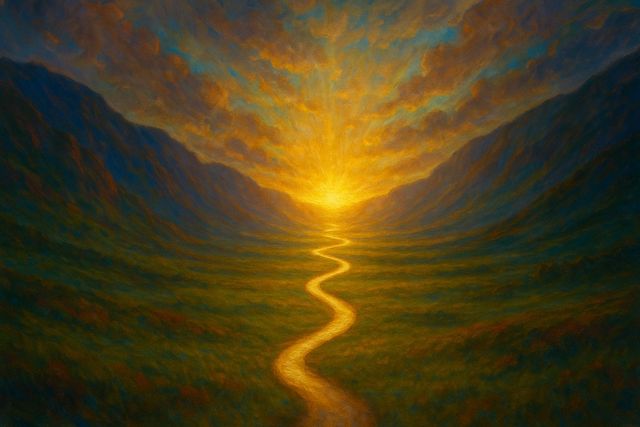
One road, and the Way it points to
A Way in the Wilderness
There are places with no road because no one has ever needed to cross them. And there are places with no road because crossing them seems impossible. The wilderness of Isaiah's world was the second kind: waterless, trackless, the ground between survival and death. To speak of a road there was not to describe an inconvenience but a wall. So when God announces in Isaiah 43 that He will make a way in the wilderness, He is not promising a shortcut. He is promising to do what the land itself declares cannot be done. This piece follows that promise. Isaiah 43:19 pairs two impossible things, a road through the desert and rivers in the wasteland, and hangs them both on a phrase that unsettles a backward-looking people: I am doing a new thing. The road here is not the old caravan track rediscovered. It is a way where there was none, made by the one who made the wilderness.
“Behold, I will do a new thing; now it shall spring forth; shall ye not know it? I will even make a way in the wilderness, and rivers in the desert.”Isaiah 43:19
The way in Scripture
Isaiah 43 is spoken to a people defined by their past. The chapter opens by reminding them who formed them and redeemed them, and it recalls the great deliverance that shaped their identity, the passage through the sea when the waters were divided and the pursuing army drowned. That memory was the anchor of the nation. To be an Israelite was to be a person of the exodus, a person whose God had once made a dry road through the middle of the water. Then, in verses 18 and 19, Isaiah does something almost shocking. He tells them not to remember the former things, not to dwell on the things of old. For a people whose whole hope lived in that memory, this is a jolt. And the reason given is that God is about to do a new thing, something that will spring forth, and the question is whether they will even perceive it. The old deliverance was real, but it was becoming a place to live rather than a lesson to learn. The new thing is then named in the same verse: a way in the wilderness and rivers in the desert. Notice the reversal from the exodus. At the sea, God made dry land appear in the midst of water. Now He promises water in the midst of dryness, and a road in the midst of pathless waste. The pattern is the same, God overcoming the terrain, but the specific miracle is new, fitted to a new need. The people are no longer trapped against a sea; they are scattered across a desert, and the way home runs through wasteland. Isaiah 43 continues in verses 20 and 21 by describing the wilderness itself honoring God, the wild creatures giving thanks because He gives water in the desert for His people to drink. The road, in other words, comes with provision. It is not a bare path across a still-deadly land. The making of the way and the giving of the rivers are one act. God does not merely point out a direction through the wilderness; He remakes the wilderness enough to carry His people across it alive.
What it comes to mean
The heart of this passage is the phrase, a new thing. It cuts against a deep human instinct, the instinct to secure ourselves by clinging to what God has already done. The exodus was genuine and glorious. But Isaiah warns that even a true memory can become a cage if it teaches us to expect God only in the shape He took before. The command not to remember the former things is not contempt for history; it is a summons to stop confining God to it. This matters because the people addressed were facing a wilderness the exodus pattern did not fit. They needed a way through a desert, not a way through a sea. And the temptation of anyone who has known God's help is to wait for the old kind of help to return, and to miss the new road because it does not look like the old one. Isaiah's warning is pastoral: the new thing may spring up unrecognized precisely by those who love the former things most. The second weight of the passage is the sheer creativity of the claim. A way in the wilderness is not the improvement of an existing path. It is a road where the terrain says no road is possible. This is the language of creation, of God speaking into absence and calling forth what was not there. The same God who made the wilderness can make a way through it, because the wilderness was never an obstacle to Him, only to us. We should be honest that this promise was not a guarantee of ease. The people who received it still had to walk. The rivers in the desert were real, but the journey was long, and the return from exile in history was partial, slow, and mixed with disappointment. Isaiah is not promising a magic road that removes all difficulty. He is promising that where there is no way, God Himself will be the way-maker, and that the wilderness will not have the last word. Gathered together, the meaning is this: God is not limited to the roads He has built before, and He is not stopped by ground that offers no road at all. His people are asked to loosen their grip on the shape of past deliverance, to lift their eyes, and to perceive the new way springing up even in the driest place. The making of a road in the wilderness is God's signature: He specializes in ways where there are none.
How it points to Christ, the Way
The Gospels open with a wilderness and a voice. When Mark begins his account of Jesus, he reaches back into Isaiah for the image of a way prepared in the wilderness, and John the Baptist stands in the desert as the one preparing it. The evangelists are signaling that the new thing Isaiah promised has begun, that the way through the wasteland is being cleared for a deliverance greater than the return from exile. In Jesus, the way in the wilderness becomes a person. He is led into the wilderness Himself, He faces its testing, and He comes through it, opening a road that His people could not open for themselves. Where sin had made the whole human landscape a trackless waste, He makes a way, not by improving what was there, but by doing a genuinely new thing, the kind of new that only the creator can do. And the pairing Isaiah kept together, the road and the rivers, holds in Christ too. He does not only make the way; He gives the living water that lets travelers survive it. To those parched in the desert of their own lives He offers water that becomes a spring. The way in the wilderness and the rivers in the desert meet in one place, in the one who is both the road home and the drink for the journey.
Questions people ask
Why does Isaiah 43 tell people to forget the exodus they were told to remember?
It is not contempt for the exodus, which the same chapter honors. It is a warning against confining God to the shape of past help. The people faced a desert, not a sea, and needed a new kind of deliverance. Clinging to the former thing could blind them to the new way God was about to spring up.
Was the way in the wilderness a promise of an easy journey?
No. The people still had to walk, and the historical return from exile was slow and partial. Isaiah promises that where no road exists, God Himself becomes the way-maker, and that provision, the rivers in the desert, comes with the road. It removes impossibility, not effort.
